DIY Drink Stations: Self Serve Cocktail Setups for Events
 General
A self serve cocktail station hands the mixing step to the guest. Measured spirit, prepared mixers and garnish sit in a controlled setup, and the guest builds the drink. Done properly it clears queues at an event, creates a talking point in a lounge, and keeps pour cost under control. Done carelessly it becomes an open bar with no measurement. This guide covers the difference, and how to build the first version.
Key Takeaways
- Self serve works when the pour is measured at the source, and fails the moment guests control the volume themselves.
- Throughput at an event is limited by the number of build positions, not by how fast any one guest works.
- A portable station suits banquets and outdoor events where a full bar technology install is impossible.
- Treat the station as theatre with controls attached, because the experience is what guests actually remember.
What a DIY drink station is and why guests like it
A DIY station presents the components of a cocktail separately and lets the guest assemble them. Spirit is dispensed in a fixed measure, mixers and juices sit in labelled dispensers, and garnishes, ice and glassware are laid out in sequence. The guest chooses a recipe card and follows it.
The appeal is participation. A guest who builds their own drink remembers the drink, photographs it and talks about it. That is worth more to a lounge or an event host than a marginally better drink built by a bartender out of sight, which is why the format spreads through experiential venues rather than through classic bars.
It also removes a specific bottleneck. At a reception with three hundred guests arriving in twenty minutes, no realistic number of bartenders can serve everyone quickly. A station with six build positions serves six people at once and does not slow down as the queue grows behind it.
For the operator the attraction is different again. The station occupies floor space that would otherwise need a full bar build, it can be moved, and it needs supervision rather than skilled labour. One trained person supervising a station covers what two bartenders would otherwise handle at a busy reception.
None of this replaces a proper bar. Complex builds, fresh shaking and any drink needing technique still belong with a bartender or with a robotic cocktail and mocktail station. The DIY station covers the volume end of the menu, where the recipes are simple and the appeal is participation.
The format also solves a menu problem. Guests with dietary restrictions, low alcohol preferences or simple personal taste can adjust their own drink without a negotiation at the bar. That flexibility is increasingly expected at Indian weddings and corporate events where the guest mix is genuinely wide.
Pour control, cost and where self serve goes wrong
The failure mode is always the same. If the guest controls the spirit volume, cost control disappears within an hour. Bottles emptied into open dispensers, free pouring from a decanter and unmeasured jiggers all produce the same outcome, which is a pour cost nobody can reconcile the following morning.
The fix is to measure at the source. Spirit should come from a portioned dispenser that delivers a fixed measure per activation, or from pre measured vessels prepared behind the bar in the same way a cocktail shaker service would be portioned. Everything downstream of the spirit can be self serve safely, because mixers and garnish are cheap and guests self regulate on volume anyway.
That single design decision separates a controlled station from an open bar. It also makes the station auditable. Counting activations or counting empty pre measured vessels gives you a consumption figure that reconciles against stock, which is exactly what an event client or a finance team will ask for afterwards.
Ice is the second cost sink and gets almost no attention. Guests over ice their drinks, ice melts faster in Indian conditions than most planners assume, and a station running dry on ice halfway through a reception is a visible failure. Plan ice volume generously and keep it replenished from a dedicated back of house source.
Glassware breakage rises at self serve stations, so specify accordingly. Many operators move to heavier tumblers or to acrylic for outdoor events, and pairing the station with a super chilled mug and glass option gives guests a reason to handle the glass more carefully.
Finally, control the recipe list. Six well chosen builds work far better than twenty. A short list is easier to stock, easier to sign and easier for a guest to choose from while people wait behind them, and it keeps the station looking curated rather than chaotic.
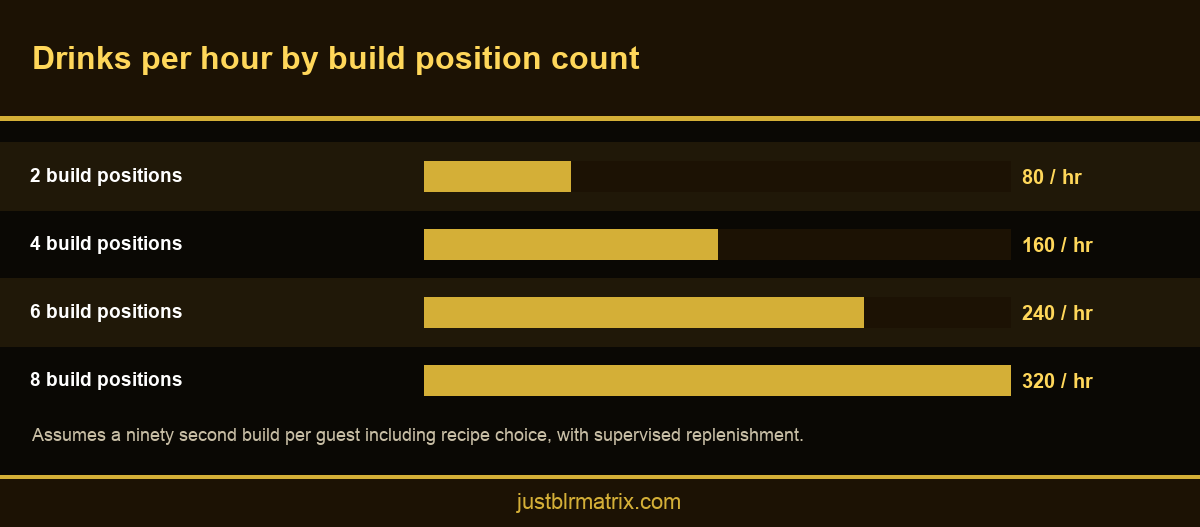 Bar chart showing DIY drink station throughput by number of build positions
Sizing a station for events and lounges
Throughput is a function of build positions. Each position is one guest assembling one drink, and a build takes roughly ninety seconds including choosing. Six positions therefore clear around two hundred and forty drinks an hour, which is the number to plan against rather than any figure about the equipment itself.
For a reception, size against the arrival peak rather than the total guest count. Three hundred guests arriving across twenty minutes need capacity for roughly one hundred and fifty drinks in that window, which points to two stations rather than one no matter how large a single station is.
For a lounge the calculation is different. The station is a fixture rather than a surge tool, so size it against your busiest hour and accept a queue at the very peak. A permanent station also justifies better fittings, plumbed drainage and proper refrigeration, none of which suit a portable setup.
Layout matters as much as capacity. A linear run with a single entry and exit keeps guests moving in one direction. An island setup looks better but creates cross traffic and confusion about where the queue starts, which is how a station that had enough positions still ends up looking congested.
Supervision is non negotiable. One trained person keeps stock replenished, resets the station between waves, answers questions and quietly enforces the pour control. That role is the difference between a station that runs cleanly all evening and one that needs rebuilding at nine o'clock, as any operator running bar technology at scale will confirm.
Plan the reset cycle explicitly. Every forty five minutes or so the station needs garnish topped up, spills wiped, glassware restocked and ice replenished. Building that into the staffing plan keeps the station presentable, and a presentable station is what guests photograph and post.
Portable setups, outdoor events and buying checks
Indian event work is largely outdoor and largely temporary, so portability is a genuine specification rather than a nice extra. A station that packs into cases, sets up in twenty minutes and needs only a power point suits banquet lawns, rooftop venues and destination weddings far better than anything requiring plumbing.
Ask about the setup and teardown time with a stopwatch, not in principle. Event teams work to tight venue windows, and a station that genuinely deploys in twenty minutes is worth substantially more than one that takes an hour, because the hour comes out of the same window as everything else the team must build.
Temperature control outdoors is the hardest part. Mixers warm quickly, ice disappears, and a station that looked excellent in an air conditioned showroom struggles on a lawn in May. Ask specifically what the supplier recommends for outdoor Indian conditions and whether insulated wells are included or extra.
Check the surfaces and the drainage. Self serve means spills, and spills at a station without a drip channel end up on the floor. A stainless top with a recessed drip tray that empties into a removable container is worth specifying, because the alternative is a member of staff mopping continuously.
Confirm cleaning and sanitation between events. Dispensers, nozzles and lines all need stripping, and a design that cannot be cleaned quickly will not be cleaned properly under event pressure. The same principle applies across every bar machine that touches a beverage line.
Finally, decide whether you are buying or hiring. Venues running events weekly should buy. Operators running four events a year almost always do better hiring, and any supplier unwilling to discuss both options is selling equipment rather than solving the problem you actually have.
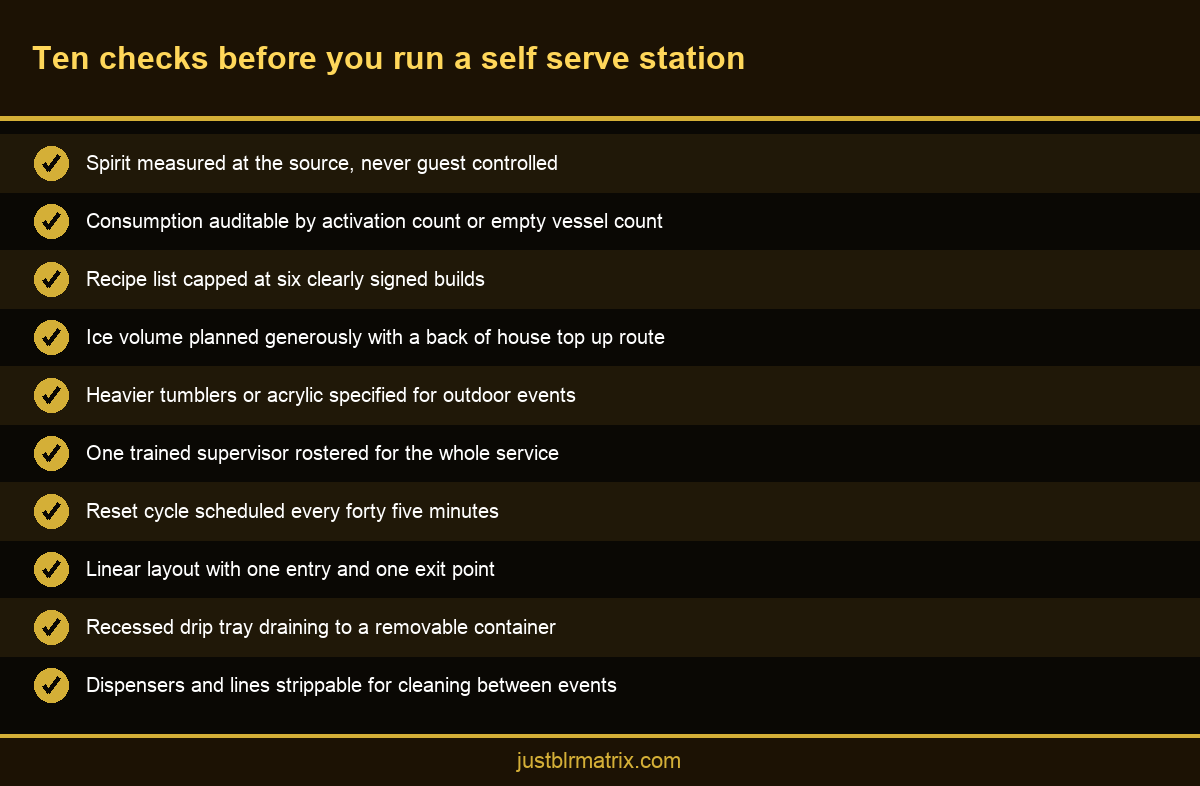 Checklist infographic of ten operational checks for a DIY self serve drink station
Conclusion
A DIY drink station is one of the few bar investments that improves guest experience and pour control at the same time, provided the spirit measure is fixed at the source. Size it by build positions against your arrival peak, keep the recipe list short, staff a supervisor, and specify for outdoor Indian conditions if you work events. Enquire now and we will spec a station against your venue and guest counts.
Frequently Asked Questions
What is a DIY drink station?

How do you stop guests over pouring the spirit?
How many drinks can a station serve per hour?
How many stations does a three hundred guest reception need?
Does a DIY station replace bartenders?
Are DIY stations suitable for outdoor Indian events?
How many recipes should the station offer?
What are the main hidden costs?
Should I buy or hire a DIY drink station?