Bar Automation Systems: The Complete 2026 Guide
 General
Bar automation is no longer a novelty reserved for airport lounges and hotel showpieces. It is now an operational answer to three problems every Indian venue faces at once: rising labour costs, inconsistent pours, and service that collapses the moment a rush arrives. This guide explains what an automated bar system actually includes, what each component fixes, what it costs, and how long it takes to pay for itself. It is written for operators, not engineers.
Key Takeaways
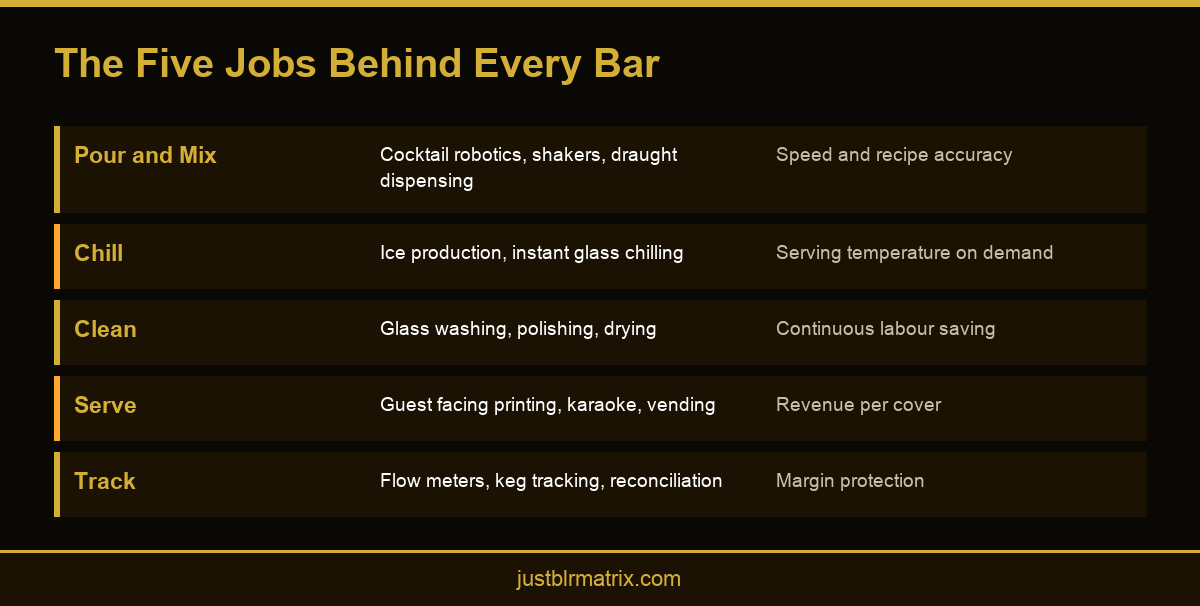
- Bar automation covers five distinct jobs: pour and mix, chill, clean, serve, and track. Most venues only automate one and leave the others manual, which caps the return.
- The largest measurable savings usually come from draught metering and glassware handling, not from cocktail robots, even though cocktail robots attract the most attention.
- A realistic automated bar rollout is staged over two to three quarters rather than installed in one go, so service is never fully interrupted.
What Bar Automation Actually Covers
The phrase bar automation gets used loosely, which makes it hard to compare quotes. In practice it covers five separate jobs behind the counter, and a venue can automate any one of them independently. Understanding the split matters because the cheapest component is rarely the one holding your service back.
Most operators start with the drink itself and stop there. That is a mistake. A robotic pour is fast, but if the glass is warm, unwashed, or missing, the bottleneck has simply moved one step down the line. Treat the bar as a chain and automate the weakest link first.
Splitting the bar this way also makes budgeting honest. A quote for a cocktail robot is easy to compare against another cocktail robot, but almost impossible to compare against a glass polisher, even though both compete for the same capital. Once you know which of the five jobs is actually costing you covers, the comparison becomes a straightforward operational question rather than a technology preference.
It also clarifies who benefits. Pour and mix automation is felt by the guest through consistency. Chill, clean and reset automation is felt by staff through workload. Serve and track automation is felt by the owner through margin. A programme that only ever pleases one of those three groups tends to stall after its first purchase.
Pour and Mix
This is the visible layer: cocktail and mocktail robotics, automatic shakers, and draught dispensing. It handles recipe accuracy and speed. A robotic cocktail and mocktail station removes the variance between your best bartender on a quiet Tuesday and your newest hire on a Saturday rush.
Chill, Clean and Reset
The invisible layer, and usually the real constraint. Ice production, glass chilling, glass washing and polishing all sit here. These tasks consume staff time continuously through a shift, yet they attract almost no attention during planning. Automating them frees more labour hours than automating the pour.
Serve and Track
The accountability layer: flow meters, keg tracking, and guest facing systems. This is where automation stops saving time and starts protecting revenue, by making every millilitre poured a measured event rather than an estimate.
The Five Bottlenecks an Automated Bar System Removes
Every bar has the same five failure points, and they surface in the same order as volume climbs. The first is recipe drift, where the same cocktail tastes different depending on who made it. The second is pour variance on draught, which quietly erodes margin without ever appearing on a report. The third is glassware supply, where service stalls because clean, cold glasses have run out. The fourth is peak hour throughput, where a queue forms and guests leave. The fifth is stock reconciliation, where closing stock never quite matches sales.
An automated bar system addresses these in a specific sequence. Recipe drift and pour variance are solved by measurement. Glassware supply is solved by parallel processing, meaning the machine washes and chills while staff serve. Throughput is solved by removing the slowest manual step, which in most Indian venues is not mixing but garnishing and glass handling. Stock reconciliation is solved by metering.
The important point for a purchase decision is that these five problems have different costs. In a high volume beer venue, pour variance alone can account for a larger annual loss than the entire cost of the metering hardware. In a cocktail led lounge, recipe drift and throughput dominate. Diagnose before you buy. The India Food Services Report published by the National Restaurant Association of India is a useful external benchmark for where your venue sits on cost structure.
Diagnosis is simpler than it sounds. Stand behind your own bar during your busiest hour and note every moment a bartender stops serving. Most managers expect to see time lost to mixing. In practice the pauses are usually caused by reaching for a clean glass, waiting for ice, or correcting a poured drink. Those pauses are the bottleneck, and they are rarely where the budget goes.
Volume changes the ranking. At low volume, recipe drift dominates because there is time to make drinks properly and the failure is one of skill. At high volume, supply constraints dominate because there is no time at all and the failure is one of capacity. A venue growing quickly will move from the first problem to the second without noticing, which is why equipment that felt adequate last year can feel useless this year.
Cocktail and Mocktail Robotics
Cocktail robotics is the most visible category in bar technology 2026 and the one guests notice first. The operational case, though, is consistency rather than spectacle. A machine pours the same measure every time, which means your margin per drink is a fixed number rather than a range.
There are two broad formats. Compact single arm units sit on the back bar and handle a defined recipe list, which suits venues with a tight signature menu. Full stations handle wider menus and higher throughput, which suits high volume lounges and banquet operations. A single arm robobar fits the first case; a full station fits the second.
Mocktails deserve separate consideration. The non alcoholic segment has grown quickly in Indian metros, and mocktails are often prepared by the same staff during the same rush, using the same glassware. Automating only the alcoholic side leaves half the bottleneck untouched. Choose equipment that handles both.
For a detailed feature and price comparison across formats, see our guide to the top robotic cocktail machines for bars in India. If you are building the financial case rather than the shortlist, the robotic cocktail machine ROI breakdown sets out the staffing maths in more detail.
Menu design should follow the equipment decision rather than precede it. A machine configured around a fixed list of signature serves performs far better than one asked to handle an unrestricted menu, and the difference shows most clearly during a rush. Venues that succeed with cocktail robotics usually narrow the menu slightly at the same time, concentrating volume into the drinks the machine handles best while leaving genuinely bespoke work to staff.
Staff response is worth planning for as carefully as the installation. Bartenders who see a machine as a judgement on their skill will find ways to work around it, and a bypassed machine returns nothing. Framed as removing the repetitive measured steps so the team can concentrate on guests, service recovery and the drinks that genuinely need craft, adoption is usually straightforward and quick.
Draught Beer: Dispensing, Metering and Keg Accountability
Draught is where most Indian bars lose money without noticing. Losses come from three sources: foam during pouring, over pouring by staff, and unaccounted volume between the keg and the glass. Individually each looks trivial. Combined across a year in a high volume venue, they are frequently the single largest controllable loss on the beverage side.
Automation attacks this in two layers. Dispensing hardware such as a robotic draught and craft beer dispenser controls the pour itself, producing a consistent head and reducing waste from repeated top ups. Metering hardware sits on the line and counts what actually flows, which turns draught from an estimate into a measured input.
The metering layer is often the better first purchase because it can be retrofitted. A beer tracking meter that fits existing taps of any brand does not require replacing your bar. It simply tells you the gap between what left the keg and what appeared on the bill. Once that number is visible, it tends to shrink on its own.
Line quality matters as much as hardware. The Draught Beer Quality Manual from the Brewers Association remains the standard reference on line cleaning, temperature and pressure, and no amount of automation compensates for a poorly maintained line. Our guide to robotic beer dispensers and flow meters covers the hardware options in more depth.
The behavioural effect of metering is frequently larger than the mechanical one. Once staff know that volume is measured rather than estimated, over pouring reduces without any further intervention. Several operators report that the majority of their recovered loss appears in the first month, before any process change has formally been introduced, simply because the measurement itself changed behaviour behind the bar.
Keg level tracking closes the remaining gap. Knowing how much beer remains in each keg prevents both the mid service changeover that stalls a busy bar and the practice of discarding kegs still holding saleable volume. In multi outlet groups this also makes distribution decisions evidential rather than anecdotal, which matters when the same brand is supplied across several venues with very different consumption patterns.
Glassware: Chilling, Washing and Polishing
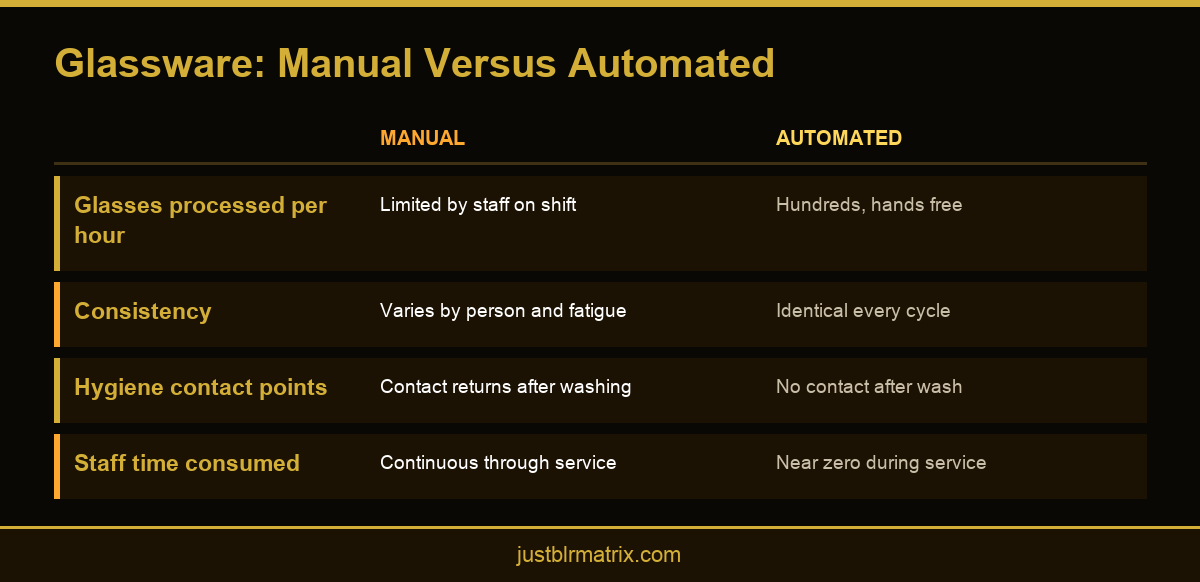
Glassware is the least glamorous part of a bar and the most common cause of stalled service. It is also the area where automation delivers the fastest, most predictable labour saving, because the work is repetitive, continuous and entirely mechanical.
Glassware is also the clearest example of why sequencing beats shopping. A bar that installs instant chilling while polishing stays manual will still run short of ready glasses during a rush, because the constraint was never temperature. Equally, a bar that automates polishing but stores glasses on an open shelf in a warm room will serve clean glasses that ruin the drink. The chain only performs as well as its slowest link.
Chilling and Frosting
A warm glass ruins a cold drink within a minute, and traditional freezer storage consumes space most bars do not have. Instant chilling equipment such as a super chilled mug system brings a glass down to serving temperature in seconds, on demand, without dedicating a freezer to glassware. This matters most in Indian venues, where ambient temperatures work against you for most of the year.
Washing and Polishing
Manual polishing is slow, inconsistent, and a hygiene risk because it reintroduces contact after washing. A glass wiper and polishing machine processes hundreds of glasses per hour hands free, which removes both the labour cost and the contamination point. For general background on mechanical warewashing principles, Wikipedia has a clear overview of dishwasher operation.
Ice as the Hidden Bottleneck
Ice is treated as a consumable rather than a constraint, which is why it causes so many service failures. A bar that runs out of ice at 9pm has effectively closed, regardless of how much stock or how many staff it has.
Sizing is where most venues get it wrong. Ice requirement is driven by covers, drink mix and ambient temperature, not by bar size. A cocktail led venue in Bengaluru consumes considerably more ice per cover than a beer led venue of identical seating. Buying a machine sized to the room rather than to the menu is the most common purchasing error in this category.
Format matters too. Standard cubes serve general mixing, while larger format cubes melt slower and suit premium spirits served neat or on the rocks. A 5 cm ice cube machine targets that premium segment specifically. Venues running a craft cocktail programme increasingly treat ice as a menu component rather than a utility, and the equipment choice should reflect that.
Space constrained bars should look at combined units. An edible ice machine with an integrated glass chiller delivers two functions from one footprint, which is often the deciding factor behind a crowded counter. For technical background on production methods, Wikipedia covers commercial ice machine types.
Storage deserves as much attention as production. A machine rated generously across twenty four hours can still empty its bin inside a three hour peak, which is the only window that matters. When comparing quotes, ask for both the hourly production rate and the storage capacity, then check the pair against your busiest hour rather than against your daily total.
Water quality is the other variable that quietly determines performance. Untreated supply carrying high mineral content leaves scale on production surfaces and reduces output steadily, so a correctly sized machine starts behaving like an undersized one within months. Filtration is not optional in most Indian locations and its running cost belongs in the purchase comparison rather than in a later maintenance surprise.
Guest Facing Bar Technology
Not every automation investment targets cost. Some target spend per guest and dwell time, and these tend to have shorter, more visible returns in venues competing on experience rather than price.
Personalisation is the clearest example. A system that prints a guest image onto a cocktail or beer head, such as Insta Face on cocktail, mocktail and beer, converts a standard drink into a shareable moment. The commercial effect is twofold: a higher price point on that drink, and organic social reach the venue does not pay for. Our post on the Insta Face drink printer covers the engagement numbers in detail.
Entertainment automation is the second category and is almost entirely overlooked. An AI song request and smart karaoke control system removes the staff member who otherwise spends the evening managing requests, while giving guests direct control. In lounge and pub formats this both reduces labour and extends dwell time, which is the metric that actually drives beverage revenue.
The common thread is that guest facing technology should be judged on revenue per cover, not on labour saved. Applying a cost saving test to an experience investment will always make it look unjustified.
Timing these investments matters. Guest facing technology works best once the operational layers beneath it are reliable, because a venue that cannot serve a cold, clean drink promptly gains little from being able to print an image onto it. Sequence experience investments after capacity investments and they compound. Reverse the order and the novelty simply draws attention to a service problem that has not been fixed.
Costing and Sequencing a Bar Automation Rollout
Budgeting for a bar with robot bartender capability fails most often because operators price the machine and forget the installation, the training, and the service contract. Build the number properly before comparing options.
Service contracts deserve scrutiny at the point of purchase rather than afterwards. Bar equipment that stops working returns the venue immediately to the manual process it replaced, along with the labour cost it was bought to remove, so local parts availability and realistic response times matter more than headline warranty length. Ask specifically what happens on a Saturday evening, because that is when a failure will actually occur.
Finally, resist blending the numbers. A single combined payback figure across the whole stack hides which component is delivering and which is not, and it makes the second purchase decision harder than the first. Keeping labour, loss recovery and incremental revenue as three separate lines lets you see quickly which part of the programme deserves the next round of investment.
Training deserves its own slot in the plan rather than being treated as part of installation. Equipment that changes service choreography needs the team to rehearse the new sequence before a busy night, ideally during a quiet shift with the old method still available as a fallback. Venues that skip this step frequently conclude the equipment failed, when what actually failed was the introduction.
Capex Bands
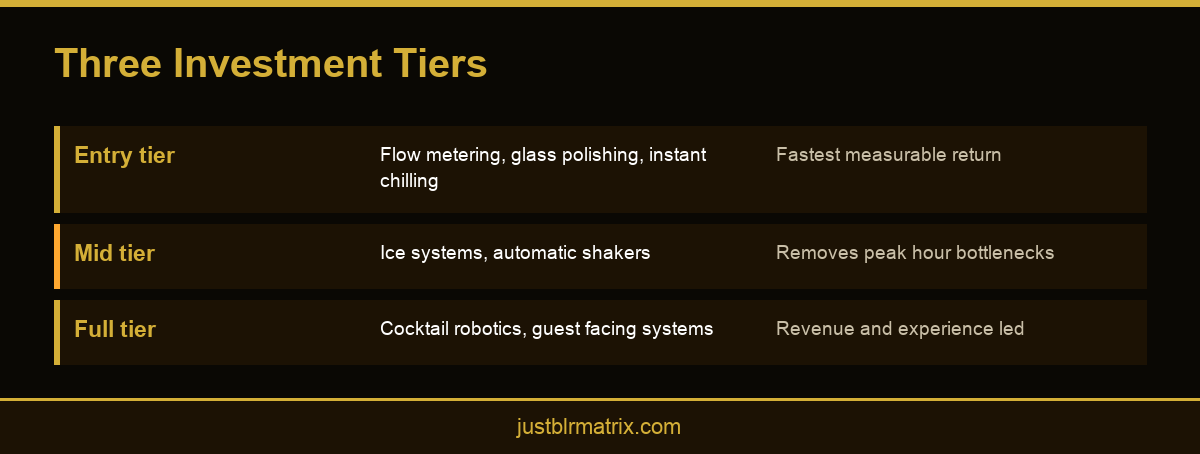
Think in three tiers. An entry tier covers metering and glassware handling, and is the cheapest route to a measurable return. A mid tier adds ice systems and automatic shakers. A full tier adds cocktail robotics and guest facing systems. Most venues should complete the entry tier before considering the full tier, because the entry tier funds the rest.
Sequencing the Rollout
The final consideration is order. A bar cannot stop trading while it is retrofitted, so sequence the work around service rather than around the invoice.
Start with retrofit items that need no structural change. Flow meters, glass polishing and instant chilling all install between shifts. These deliver measurable savings within the first month and build internal confidence in the programme, which matters when you ask for the next budget.
Move next to items needing plumbing or electrical work, principally ice machines and washing equipment. Schedule these during your slowest week and accept a temporary manual workaround for two or three days. Leave cocktail robotics and guest facing systems until last, because they change service choreography and require staff retraining, not just installation.
Across a group with multiple outlets, pilot in one venue and measure for a full quarter before rolling out. Seasonal variation in Indian venues is large enough that a single month of data will mislead you. The Indian food services industry overview from IBEF gives useful sector level context when building the business case for a multi outlet programme. For a view across kitchen and service as well as bar, see our hospitality automation company guide.
Payback Maths
Calculate payback on three lines: labour hours removed, product loss recovered, and incremental revenue earned. Metering pays back through the second line, glassware through the first, and guest facing systems through the third. Mixing all three into a single blended figure hides which investment is actually working, and makes the next purchase decision harder.
Conclusion
Bar automation works when it is treated as an operations project rather than a technology purchase. Diagnose which of the five bottlenecks is costing you most, fix that one first, measure the result, and let the saving fund the next stage. Metering and glassware usually deliver the fastest return; cocktail robotics and guest facing systems deliver the visible one. Just BLR Matrix has deployed these systems across 34 outlets and 80 plus installations, and can size a stack against your actual covers rather than a generic specification. Request a demo to start with a site assessment.
Frequently Asked Questions
What does bar automation cost for a mid sized venue?

Will an automated bar system reduce my staff count?
Can bar automation be retrofitted to an existing counter?
How long does bar automation take to pay for itself?
Does a bar with robot bartender still need trained staff?
What is the most common mistake when buying bar automation?
Is bar automation suitable for banquet and event operations?
How do I measure whether bar automation is working?
Should I automate the bar or the kitchen first?