Commercial Coffee Machines and Semi Automatic Espresso
 General
Choosing an espresso machine for a hotel bar is usually framed as a taste decision and almost never as an operations decision. For a hotel breakfast service or a cafe with a morning rush, the operational questions matter more. How many drinks in the peak fifteen minutes, who is making them, and what happens when that person leaves. This guide works through group head maths, the semi automatic against automatic choice, and the running costs that rarely appear in a quote.
Key Takeaways
- Group head count sets peak throughput, and peak is what fails, so size against fifteen minutes rather than an hour.
- Semi automatic gives control and needs skill. Automatic gives consistency and needs almost none. Pick by staffing reality.
- Water treatment is the largest hidden cost in Indian conditions and the most common cause of bar equipment failure.
- Grinder quality affects the cup more than machine brand does, yet it is usually the line that gets cut from the budget.
Group heads, peak demand and honest sizing
A group head is one brewing position. A single group machine makes one espresso at a time, a two group makes two, and a three group makes three. Throughput is set almost entirely by that count, because the extraction itself takes a fixed twenty five to thirty seconds regardless of how expensive the machine is.
Size against the peak fifteen minutes, not the day. A hotel serving one hundred and twenty breakfast covers does not need one hundred and twenty coffees an hour spread evenly. It needs perhaps forty five drinks between eight fifteen and eight forty five, and that is the number the machine must survive without a queue forming.
A realistic working figure is around sixty to eighty drinks per group head per hour with a competent operator, and rather less with a milk heavy menu. Cappuccinos and lattes take longer than espressos because steaming and texturing milk is the slow step, not the extraction.
That means milk drinks change the sizing more than volume does. A cafe selling mostly filter and espresso can run a two group comfortably. The same cafe selling mostly cappuccino needs either a third group, a second steam wand or an automatic milk system, because the wand becomes the bottleneck long before the group does.
Boiler configuration matters at the margin. A heat exchanger machine brews and steams from one boiler, which is simpler and cheaper. A dual boiler separates them, so steam pressure does not sag during a run of espresso shots. In a hotel breakfast peak, that difference is noticeable in the cup.
Finally, plan the counter, not just the machine. Grinder, knock box, cup storage, milk fridge and a clear workflow left to right all determine real throughput. A three group machine on a cramped counter delivers less than a well laid out two group, and this is where most retrofits go wrong.
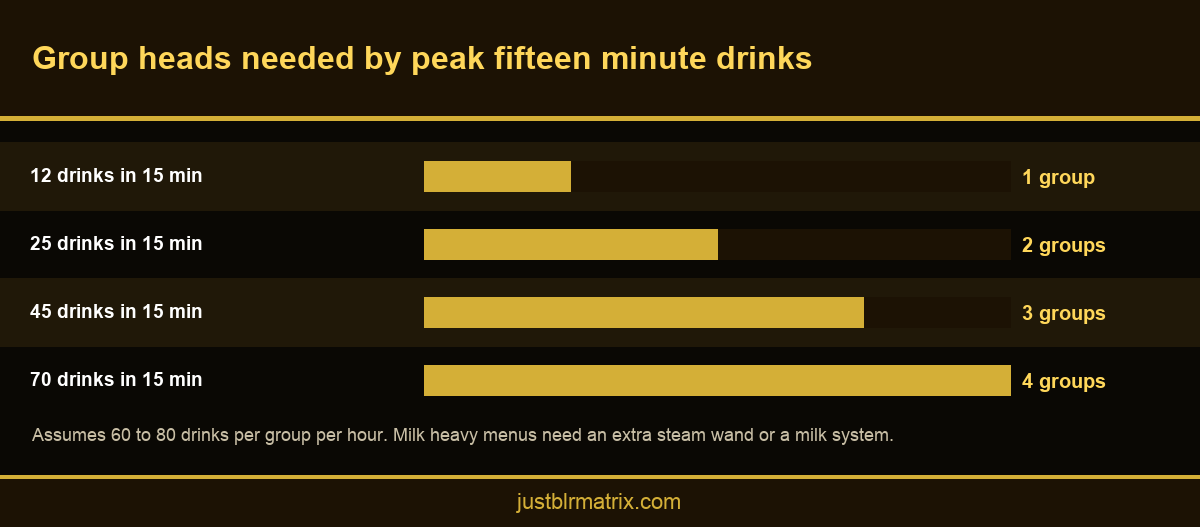 Bar chart showing commercial coffee machine group heads needed by peak fifteen minute drink counts
Semi automatic against automatic, and who is operating it
A semi automatic machine gives the operator control over dose, tamp and shot timing. In the hands of a trained barista it produces the best cup available at any given price point. In the hands of an untrained one it produces inconsistency, and hotels rotate staff far more than specialty cafes do.
An automatic machine handles grinding, dosing, tamping and extraction on a programmed cycle. The cup is good rather than exceptional, but it is the same cup every time, on every shift, with any operator. For a hotel breakfast buffet or a corporate cafeteria that consistency is worth more than a marginal quality gain.
The staffing question decides it, not the coffee question. If you can retain a trained barista, semi automatic is the right answer and the machine will reward the investment. If your coffee is made by whoever is on the breakfast shift, semi automatic will underperform a cheaper automatic every single morning.
Many venues end up with both for good reason. A semi automatic on the cafe counter where the barista works, and an automatic on the breakfast floor or in the executive lounge where guests self serve. Trying to make one machine cover both situations usually disappoints in one of them.
Training cost is real and rarely budgeted. Bringing a competent but untrained person to a consistent espresso standard takes weeks of practice with real coffee, which is both time and product. Factor that in when comparing a semi automatic quote against an automatic one that needs almost no training at all.
There is a third path worth knowing about for unattended positions. A single arm coffee bot removes the operator entirely, which suits a lobby or a late night service point where staffing a barista is not realistic but guests still expect coffee.
The running costs nobody quotes
Water treatment is first and largest. Indian municipal water is variable and frequently hard, and scale is the single most common cause of commercial espresso machine failure. A softener or reverse osmosis system with the correct remineralisation is not optional equipment, it is part of the machine purchase.
Get the water tested rather than assuming. Total dissolved solids, hardness and alkalinity all affect both extraction quality and scale rate, and the right treatment differs between Bengaluru, Chennai and Delhi. A supplier who quotes a machine without asking about water has not understood the installation.
Grinder replacement burrs are the second recurring cost. Burrs dull gradually, extraction drifts, and the team compensates by adjusting the grind until eventually the coffee is simply worse. Set a burr replacement interval by kilograms ground rather than by months, and track it.
Milk waste is the third and is almost never measured. Steaming more than the drink needs, then discarding the remainder, is standard practice in most venues. Over a year in a busy hotel that is a meaningful figure, and it responds well to simply weighing what goes in and what goes out for a week.
Energy is modest by comparison but not trivial, because a commercial machine holds a boiler at temperature all day. Machines with insulated boilers and a scheduled on and off timer cut standby consumption significantly, and the timer is free if the machine supports it and somebody sets it up.
Service contracts deserve scrutiny. Ask what is covered, what the response time is, and whether a loan machine is provided during a major repair. A hotel breakfast without coffee generates complaints immediately, so downtime cover is worth more than a small discount on the purchase price.
A buying checklist for Indian cafes and hotels
Establish the peak fifteen minute drink count first, split by milk and non milk. Every other decision follows from those two numbers, and almost nobody arrives at a supplier meeting with them. Collect the data from your till for two typical weeks before you start comparing machines.
Budget the grinder as a serious line, not an accessory. A good machine with a poor grinder produces poor coffee, and the reverse is far less true. If the budget is tight, spending more on the grinder and less on the machine is almost always the better trade.
Confirm the water treatment specification in writing, based on a test of your actual supply. Ask what replacement cartridges cost and how often they change. This single item causes more expensive failures in Indian installations than any other, and it is entirely preventable.
Check the electrical provision before delivery. Three group machines commonly need a dedicated circuit and sometimes three phase, and discovering that on installation day is an expensive delay. Get the connected load and the supply requirement from the supplier in advance.
Test drive with your own staff, not the supplier's demonstrator. Ask the person who will actually operate the machine every morning to make four drinks on it. Their reaction tells you more about whether the purchase will succeed than any specification comparison will.
Finally, think about where coffee sits in the wider service plan. It touches breakfast, room service, the bar and the lobby, and the bar technology guide sets out how beverage stations interact so that adding capacity in one place does not simply create a queue in another.
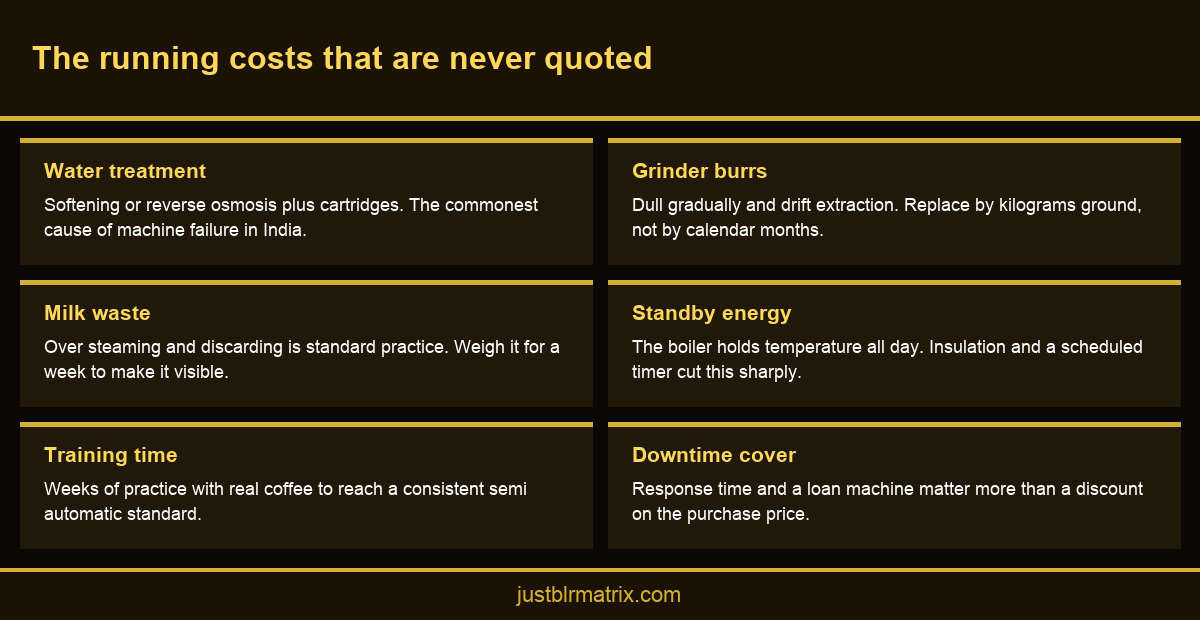 Infographic showing six hidden running costs of a commercial coffee machine in India
Conclusion
A commercial coffee machine should be chosen on peak throughput and staffing reality rather than on brand. Count your busiest fifteen minutes, split milk from non milk, and be honest about who will operate it every morning. Budget properly for the grinder and for water treatment, because those two decide cup quality and machine life more than anything else. Get a quote sized to your peak service.
Frequently Asked Questions
How many group heads do I need?

Should I choose semi automatic or automatic?
Why does water treatment matter so much in India?
Is the grinder really more important than the machine?
What is the difference between heat exchanger and dual boiler?
How do I stop milk waste?
How often should grinder burrs be replaced?
What should a service contract include?
What if I cannot staff a barista at all?