Automatic Lemon and Citrus Slicers for Bar Prep
 General
Citrus prep is the quiet tax on every bar shift. Somebody spends the first hour of the day wedging limes and wheeling lemons, and by the end of service half of it has dried out. A lime and lemon wedger turns that hour into minutes and makes every garnish identical. This guide covers the wedge and wheel maths behind a bar's citrus consumption, what these machines actually deliver, and what to check before buying one for an Indian bar.
Key Takeaways
- Citrus prep is a fixed pre shift cost that scales with covers, which makes it one of the easiest tasks to automate.
- Consistent wedge size protects both drink appearance and the cost per garnish, which nobody currently measures.
- Bar prep framing matters, because a kitchen slicer sized for vegetables handles citrus poorly in a bar setting.
- Waste falls because you cut to demand through the shift rather than cutting everything before doors open.
The real cost of manual citrus prep
Count what your bar actually uses. A busy Bengaluru bar serving four hundred drinks on a Saturday will get through six to eight kilograms of limes and lemons, cut into wedges, wheels and half wheels. At manual speed that is between sixty and ninety minutes of one person's time, every single day, before a guest has arrived.
That hour is expensive in a way that does not show on any report. It happens during the pre shift window when the same person could be setting up stations, checking stock, prepping syrups or briefing the team. Citrus prep wins that competition because it must be done, and everything else slips instead.
Consistency is the second cost. Hand cut wedges vary in thickness, which changes how much juice the guest gets, how the drink looks and how many wedges come out of each fruit. A bar cutting eight wedges from a lime rather than six is quietly running a twenty five percent higher garnish cost with nobody noticing.
Waste is the third. Because manual prep is slow, bars cut everything before doors open. Whatever is not used dries, discolours and is discarded at close. On a quiet night that can be a third of the day's citrus, which over a month is a genuinely material number for a product bought fresh.
There is also a safety dimension. Repetitive knife work under time pressure is a recognised source of kitchen and bar injuries, and the guidance published for catering operations treats repetitive cutting as a hazard worth designing out rather than managing through care alone.
Put together, citrus is unusual among bar tasks. It is high volume, entirely mechanical, has no craft value worth preserving, and is performed at the busiest planning moment of the day. Those four properties are exactly what make a task a good automation candidate.
What an automatic citrus slicer actually does
A bar citrus slicer holds the fruit in a cradle and drives it through a fixed blade array in one motion. The blade set determines the output. A wedge array produces six or eight wedges per fruit. A wheel array produces even slices at a set thickness. Changing output means changing the array rather than adjusting a setting.
Cycle time is short, usually two to four seconds per fruit including loading. That means a kilogram of limes takes a couple of minutes rather than fifteen. The practical effect is that prep stops being a block of time and becomes something a bartender does in the gaps between service peaks.
That shift is the real operational benefit. Cutting to demand rather than cutting in advance means garnish is fresh at eleven at night, not eleven in the morning. Guests notice, and the waste at close drops sharply because you only cut what the evening actually consumed.
Blade array choice deserves thought. Most Indian bars need a six wedge lime array and an even wheel array for lemon. A lime wedger and fruit slicer that accepts both, with a quick change between them, covers almost the entire garnish list without a second machine on the back bar.
Fruit size tolerance matters more than the specification sheet suggests. Indian limes vary considerably by season and supplier, and a cradle sized for a uniform imported lime will crush small fruit and jam on large ones. Ask to run your own supply through the machine before committing.
Manual lever units and powered units both exist. A lever unit is cheaper, quieter and needs no power at the bar, which suits a small venue. A powered unit is faster and less tiring across volume, which matters once daily consumption passes a few kilograms.
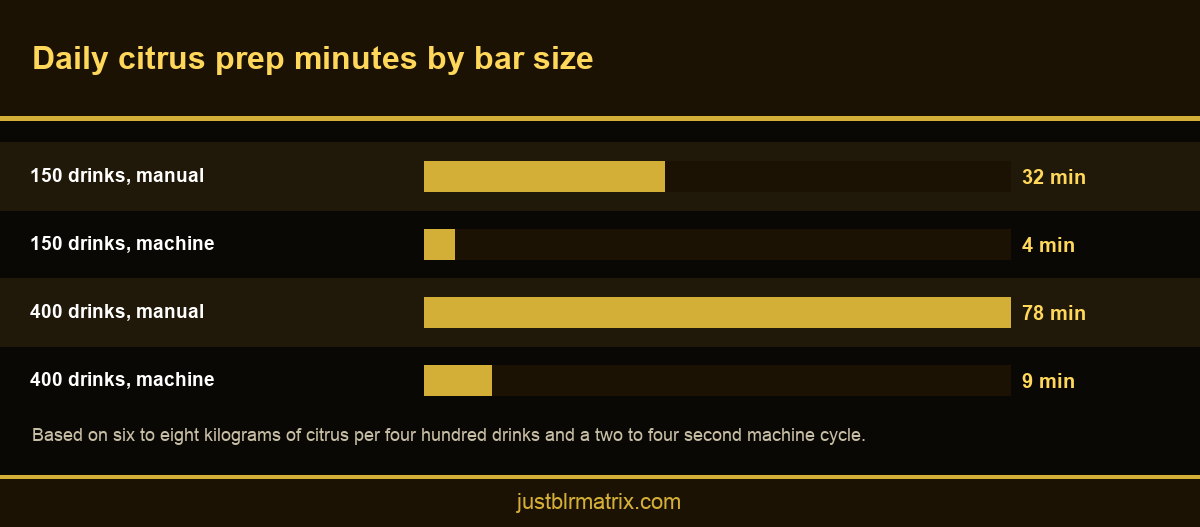 Bar chart comparing manual and automated citrus prep minutes at different bar volumes
Fitting it into the bar, not the kitchen
The single most common mistake is buying a kitchen vegetable slicer and expecting it to serve the bar. Kitchen machines are sized for volume prep of firm produce, they are large, and they live in the kitchen, which is exactly where a bartender cannot reach them during service.
Position matters more than throughput here. A citrus slicer on the back bar or under the counter gets used through the shift. The same machine in the kitchen gets used once in the morning, which returns you to cutting in advance and eliminates the waste benefit entirely.
Footprint and noise therefore become real specifications. A compact unit that sits within arm's reach of the garnish tray and does not startle guests when used mid service is worth more than a faster machine that has to live elsewhere. Measure the space you actually have before you shop.
Cleaning access is critical because citrus is acidic and sticky, and a peeler or slicer that traps residue behaves the same way. Blade arrays must lift out, the cradle must wash, and everything must dry properly. A design that traps pulp behind a fixed guard will grow a smell within a week in Indian conditions and will fail an inspection soon after.
Material choice follows from that. Stainless blades and food safe polymer for the cradle are the standard, and citrus acid attacks lesser materials quickly. This is the same specification logic that applies to every bar machine handling fresh product rather than packaged mixers.
Finally, think about who operates it. A machine used by every bartender on every shift needs to be obvious. If it requires a technique or a knack, it will be used by the two people who learned it and avoided by everyone else, which is how expensive equipment quietly stops being used.
Buying checks and the payback maths
Start by measuring your own consumption for a week. Weigh the citrus that goes into garnish, count the drinks served, and time the prep. Those three numbers give you a cost per garnish and a prep hours figure, and every subsequent comparison depends on having them rather than estimating.
Then measure yield. Count how many usable wedges your team currently gets from a kilogram of limes, and compare that against the machine's array count. A move from an inconsistent seven wedges to a consistent six sounds like a loss until you notice the seven included two unusable slivers.
Model the waste reduction separately. If you currently discard a quarter of prepped citrus on quiet nights, cutting to demand recovers most of that. Apply the recovery to your monthly citrus spend and it is frequently the largest single line in the payback calculation for a mid sized bar.
Ask about blade replacement cost and interval. Blades dull, citrus acid accelerates it, and a machine whose arrays are expensive or slow to source becomes a problem in month eight rather than month one. Get the part number, the price and the lead time in writing before you sign anything.
Confirm the machine handles the full citrus list on your menu. Lime, lemon, orange and occasionally grapefruit all appear on Indian bar menus, and they differ enough in size and skin thickness that a single array will not flatter all of them. Establish which fruits need which array.
Finally, place the purchase in the wider plan. Citrus prep sits alongside ice, glass chilling and pour control as one of the small operational costs that add up, and the bar technology guide sets out how those pieces interact so that one fix does not simply move the bottleneck along the counter.
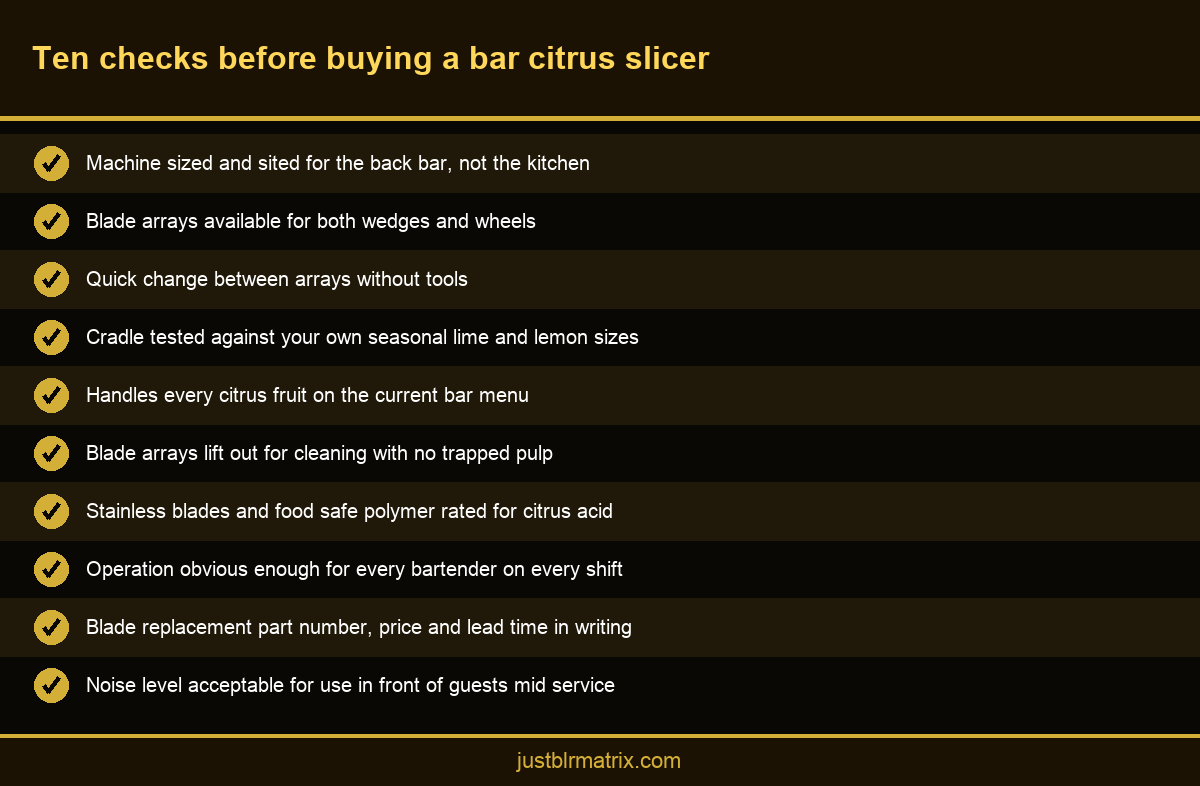 Checklist infographic of ten buying checks for an automatic lemon and citrus slicer in a bar
Conclusion
An automatic lemon slicing machine is a small purchase that removes a large recurring irritation. It returns an hour of pre shift time, standardises garnish cost, and cuts waste by letting the bar cut to demand rather than in advance. Specify it for the bar rather than the kitchen, test it on your own fruit, and check blade array availability before buying. Enquire now for a unit matched to your menu.
Frequently Asked Questions
What does an automatic lemon slicing machine do?

How much prep time does it actually save?
Will it reduce citrus waste?
Can I use a kitchen vegetable slicer instead?
Does it handle Indian lime and lemon sizes?
How often do the blades need replacing?
Should I buy a manual lever or a powered unit?
How does it affect garnish cost per drink?
What else should sit on the same prep list?