AI Karaoke and Song Request Systems for Bars and Lounges
 General
An AI song request and smart karaoke control system does something no bar manager enjoys doing manually. It runs the queue, enforces fairness, filters requests, controls volume and keeps the room moving without an argument at the console. For a lounge, that turns an unpredictable evening into a managed one. This guide covers how these systems work, what drives the price, how licensing works in India, and the revenue case for putting one in.
Key Takeaways
- The value is queue management and fairness, not the singing itself, because the queue is what causes disputes.
- Price is driven by zone count, screen count and licensing, so scope those three before comparing quotes.
- Entertainment tech is the least covered corner of bar technology, which makes it a differentiator.
- Measure the return in dwell time and spend per head, not in cover charges, because that is where it actually lands.
What a smart karaoke system actually manages
Traditional karaoke in a bar runs on a laptop, a folder of tracks and whoever is standing nearest the console. The result is predictable. The loudest table sings most, quieter guests never get a turn, and the person managing the queue spends the evening apologising rather than serving. That is the problem the technology solves.
A smart system moves the request to the guest's phone through a QR code or a short link. Guests search the catalogue, submit a request and see their position in the queue. Nobody has to approach a console, and nobody can jump the queue by being persistent, because the order is enforced by software rather than by negotiation.
Fairness rules are where the AI layer earns its name. The system can limit requests per table, rotate between sections of the room, promote guests who have waited longest and prevent a single group monopolising the evening. Those rules are configurable per venue and per night, which manual management cannot achieve reliably.
Content filtering matters more than operators expect. A public request queue in a licensed venue needs moderation, and doing it manually means someone reading every submission. Automated filtering against a blocked list, plus a hold and approve step for the host, removes the risk without slowing the queue down.
Audio control is the other half. The system manages track volume against ambient level, ducks background music cleanly between performances and can zone the room so a karaoke section does not overwhelm a dining area. In a multi zone lounge that capability is the difference between a feature and a complaint.
Reporting is the part nobody asks about and everyone uses. Which nights fill the queue, which tracks recur, how long the average guest waits and which tables participate most all become visible. That data feeds programming decisions far better than the manager's impression of last Saturday.
What drives the price of a system
Zone count is the first driver. A single room with one screen and one audio path is the simplest install. A lounge with a main floor, a mezzanine and private rooms needs independent audio and queue control per zone, and the price scales roughly with that count rather than with floor area.
Screen count and placement follow. Guests need to see the lyrics, the queue position and usually a now playing display. Retrofitting screens into an existing room is often the largest line in the quote, because cabling and mounting in a finished venue is more disruptive than the hardware cost suggests.
Catalogue licensing is the recurring cost and the one most likely to be underestimated. A legitimate commercial karaoke catalogue is licensed, and the licence scales with venue capacity and usage. Any supplier who does not raise licensing in the first conversation is selling something you should look at more carefully.
The software layer itself is usually a subscription. Queue management, guest facing request pages, moderation and reporting are delivered as a service, which means a modest monthly cost rather than a large capital item. That structure suits venues testing the format before committing to a full build.
Microphones and audio hardware are where quality shows. Guests handle microphones roughly, drop them and spill on them. Cheap wireless units fail within months in a bar environment, and a failed microphone mid performance is a visible failure in front of a room full of people.
Finally, integration adds cost but also value. Linking the request system to your AI Command POS platform lets you attach requests to table numbers, which turns karaoke participation into a measurable driver of spend rather than an unquantified entertainment expense.
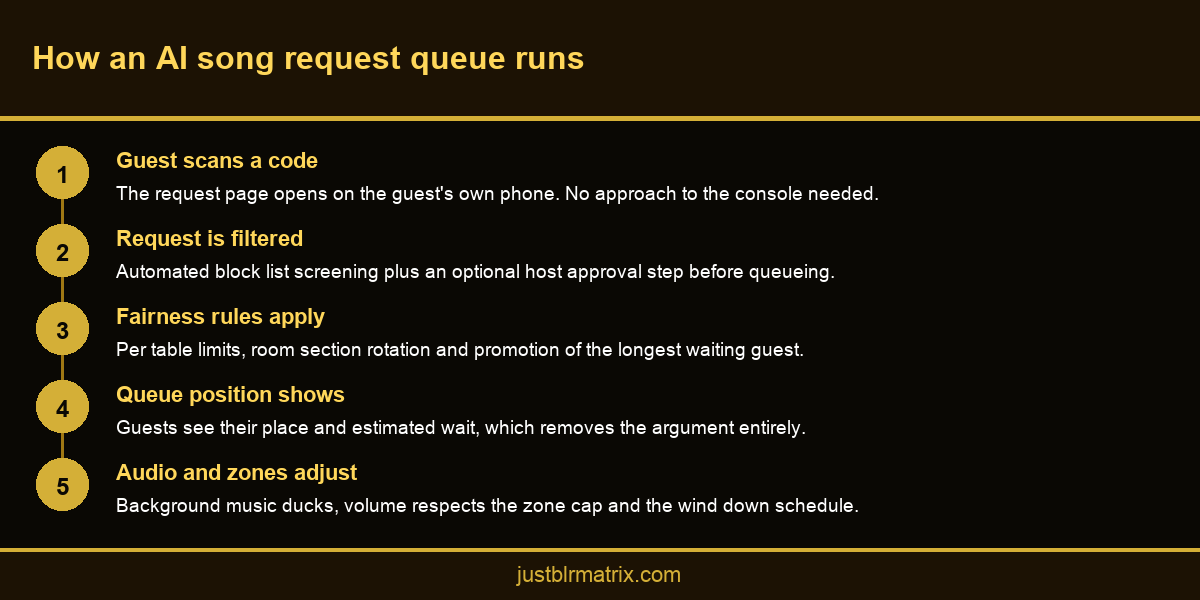 Five step infographic showing how an AI song request queue works in a bar or lounge
Licensing, compliance and running it legally in India
Public performance of recorded music in a commercial venue requires licensing in India, and karaoke adds a second layer because the lyrics and the backing track are separately licensed works. Venues that assume a background music licence covers karaoke are frequently mistaken, and the correction arrives as a demand notice.
Work through your supplier on this rather than around it. A reputable karaoke platform supplies a licensed catalogue and can tell you exactly what the licence covers and what remains your responsibility as the venue. Get that in writing, because verbal assurances are worth nothing when a collecting society visits.
Local licensing conditions add further constraints. Many Indian cities impose amplified sound curfews and decibel limits on licensed premises, and enforcement in Bengaluru in particular is active. The hospitality trade press, including coverage of the Indian hotels and restaurants sector, reports these disputes regularly. A system with zone level volume caps and a scheduled automatic wind down helps you stay inside those conditions without relying on the duty manager remembering.
Content moderation is a compliance issue as well as a taste one. A venue is responsible for what is performed on its premises, so an automated block list plus host approval is a defensible control. Document the policy and keep the moderation log, because that record is what demonstrates diligence if a complaint is made.
Accessibility and fairness policies also matter more than they used to. A visible, software enforced queue protects the venue from accusations of favouritism, and a per table request limit prevents one group dominating an evening in a way that generates complaints and poor reviews.
Finally, keep the guest data question clean. If requests come through a phone, you are collecting something. Decide what you retain, say so on the request page, and avoid harvesting contact details without a clear purpose, because a bar is not a place guests expect to be enrolled in a database.
The revenue case and how to programme it
Karaoke does not usually earn through a cover charge in India. It earns through dwell time. A guest who is in the queue stays for another round, and a group whose turn is forty minutes away orders food rather than leaving. That is the mechanism, and it is measurable if you look at the right numbers.
Measure spend per head and average dwell on karaoke nights against comparable non karaoke nights. Two weeks of each gives a defensible comparison. Most venues that run the exercise properly find the difference in dwell rather than in covers, which is exactly why cover based business cases disappoint.
Programme it as a scheduled format rather than an always on feature. Two or three nights a week builds anticipation and protects the dining experience on the other nights. Venues that leave karaoke running permanently usually find it cannibalises their quieter trade without adding much on the busy nights.
Use the queue data to programme. If the queue fills within twenty minutes on a Thursday but never fills on a Tuesday, that is a clear instruction about which night to promote. The reporting layer answers that question in a week, which no amount of managerial intuition matches.
Pair the format with the bar offer deliberately. A queue creates a predictable waiting audience, and that audience is exactly who a self serve cocktail station or a fast serve format is designed for. Entertainment and beverage throughput should be planned together rather than separately.
Finally, treat it as one part of the guest experience programme. Selfie printers, order tracking and bar machines that speed up service all pull in the same direction, and a venue that sequences them coherently gets far more from each than one that adds them piecemeal over two years.
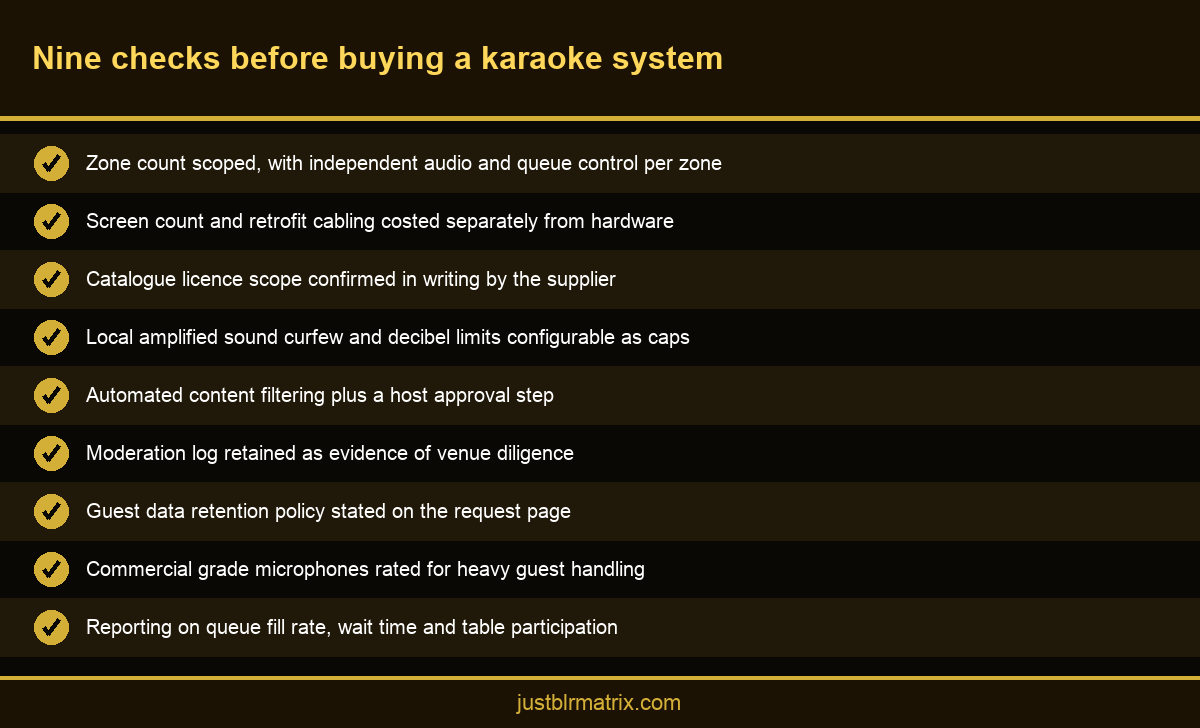 Checklist infographic of nine buying checks for a smart karaoke control system in a bar
Conclusion
A smart karaoke control system is a queue management product wearing an entertainment badge, and that is exactly why it works. It removes the argument at the console, enforces fairness in software, keeps volume inside your licence conditions, and produces data you can programme against. Price it on zones, screens and licensing, and measure the return in dwell time. Request a demo for a system scoped to your venue.
Frequently Asked Questions
What does a smart karaoke control system do?

What drives the price of a karaoke system for a bar?
Do I need a separate licence for karaoke in India?
How does the AI part actually work?
Will karaoke disturb my dining guests?
How do I measure the return on investment?
How often should a venue run karaoke?
What microphone quality should I specify?
What else pairs well with a karaoke night?