Restaurant Billing Software Price in India: What You Pay
 Service Automation in Restaurants
Every vendor quotes a monthly figure and almost none of them quote what you will actually pay. Restaurant billing software price in India is a headline subscription plus a list of add ons that appear once the outlet is live. This guide sets out what sits inside a typical quote, what sits outside it, what the free tiers genuinely give you, and how to build a three year total cost of ownership figure you can compare across vendors honestly.
Key Takeaways
- The subscription is rarely more than half of what you pay, so compare total cost of ownership rather than headline price.
- Free tiers are real but bounded, and the boundary is usually outlet count, invoice volume or reporting depth.
- Payment gateway charges, hardware and integration are the three costs most often missing from a POS quote.
- Switching cost is the number nobody models, and it is what makes a cheap wrong choice expensive later.
What a billing software quote actually contains
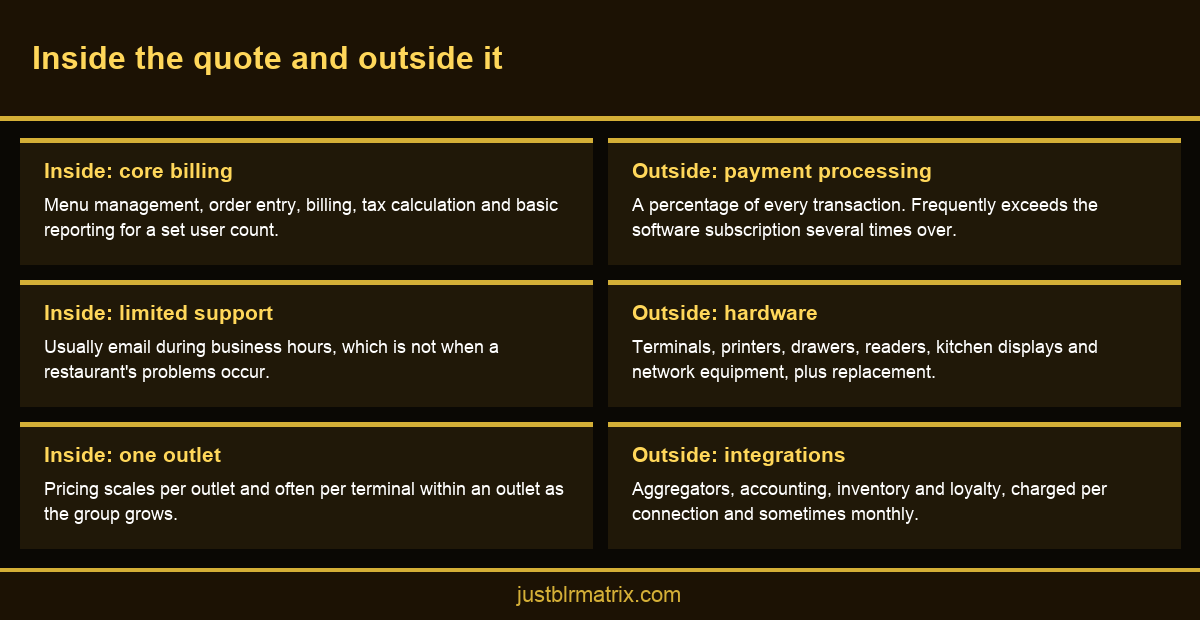
A typical quote covers the core point of sale function. Menu management, order entry, billing, tax calculation, basic reporting and a defined number of user logins. That is genuinely useful and it is what most small outlets need on day one, which is why the headline figure looks reasonable.
The count that matters is outlets and terminals, not features. Pricing almost always scales per outlet and frequently per terminal within an outlet, so a group comparing a single site quote against a multi site requirement is comparing two different products at two different prices.
Contract length changes the number considerably. Annual commitments carry meaningful discounts against monthly terms, which is fine if the vendor is right and expensive if not. Weigh that discount against the switching cost you would face if the platform turns out not to fit.
Support tier is the other variable inside the quote. Basic support usually means email during business hours, which is a poor match for a restaurant whose problems occur at nine on a Saturday evening. Priority support is an add on, and for a busy outlet it is not optional.
Data ownership deserves a direct question at quote stage. Ask who owns the transaction data, how you export it, in what format, and what happens to it if you leave. A vendor who cannot answer that clearly is telling you something about the switching cost later.
Read the fair use limits too. Many subscriptions carry caps on invoice volume, storage or API calls that never matter for a small outlet and matter a great deal for a growing group. Find the cap before it finds you during a festival week.
 Infographic comparing what a restaurant billing software quote includes against what it excludes
The add ons that appear after you sign
Payment gateway charges are the largest and most consistently omitted. A percentage of every transaction leaves through the gateway, and on a high volume outlet that annual figure can exceed the software subscription several times over. It belongs in the comparison from the start.
Hardware is the second. Terminals, printers, cash drawers, card readers, kitchen display screens and network equipment all cost money, and vendors sometimes bundle them at a subsidised rate in exchange for a longer contract, which is a financing decision dressed as a discount.
Integration charges surprise people most. Connecting to aggregator platforms, accounting software, inventory systems or loyalty programmes is frequently charged per connection and sometimes per month thereafter. List every system you need connected before you compare quotes.
Additional modules follow. Inventory, recipe costing, customer relationship management, loyalty, table reservation and analytics are usually separate line items. The base billing product is deliberately narrow because that is what keeps the headline price competitive in a crowded market.
Implementation and training are often one time charges and are worth paying properly. A poorly configured menu structure, wrong tax rates or a badly designed kitchen routing map will cost far more in daily friction than the setup fee saved by doing it yourself.
Finally, count the hardware and software that sit around the billing system rather than inside it. Self service terminals, settlement tabs and kitchen displays are part of the real cost of running the outlet even when they appear on a different invoice.
What free billing software actually gives you
Free tiers are genuine and useful, and treating them as a trick is unfair. For a single small outlet with modest volume and simple needs, a free tier can run the business competently for a long time. Many successful cafes started exactly that way.
The boundaries are usually predictable. One outlet, a limited number of users, a cap on monthly invoices, shallow reporting and no integrations. Each of those is fine until the business grows past it, and growth is precisely when changing systems is most disruptive.
Data export is the boundary to check hardest. A free tier that holds your transaction history and makes export difficult creates a switching cost that is far larger than any subscription you avoided. Test the export function in the first week, not in the month you decide to move.
Support on a free tier is minimal by design, and that is the trade. When billing stops working on a Friday evening, a free tier gives you a help article. Whether that is acceptable depends entirely on how much revenue passes through the till in the hours you would be down.
Compliance is the other thing to verify rather than assume. The software must produce correct tax invoices with correct particulars and rates for your item categories, in line with GST requirements. Free does not exempt you from that obligation.
The sensible use of a free tier is as a genuine trial with an exit plan. Run it, learn what you actually need rather than what you think you need, export your data periodically, and upgrade or move deliberately rather than under pressure when a limit is hit.
 Six step infographic showing how to build a three year total cost of ownership for billing software
Building a three year total cost of ownership
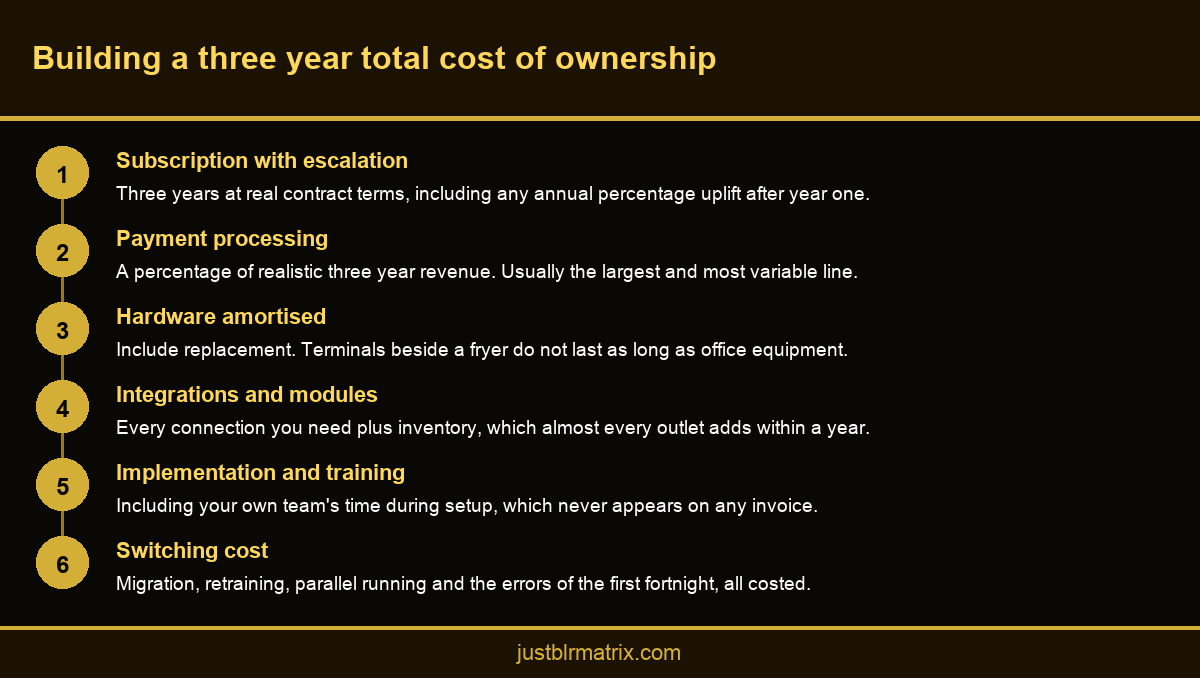
Start with the subscription across three years at the contract terms you would actually accept, including any annual increase clause. Vendors frequently include a percentage uplift after year one, and comparing year one pricing alone flatters whoever has the most aggressive escalation.
Add payment processing as a percentage of your realistic three year revenue through the platform. This single line often dominates the model and is the one most likely to differ materially between vendors, because gateway arrangements vary more than software prices do.
Add hardware, amortised, plus a realistic replacement assumption. Terminals in a food environment do not last as long as terminals in an office, and assuming a five year life on a screen that sits beside a fryer is optimistic in a way that shows up in year three.
Add every integration you need, with any recurring charge, plus the modules you will inevitably add. Most outlets that start with billing alone add inventory within a year, so include it in the model rather than pretending it is optional.
Then add implementation, training and the cost of your own team's time during setup. That last one is real even though it never appears on an invoice, and it is larger for a platform that needs heavy configuration than for one that ships closer to ready.
Finally, estimate the switching cost from your current system and add it. Data migration, retraining, parallel running and the errors of the first fortnight all cost money, which is why choosing a platform that can grow with the group matters more than saving on a monthly figure. The enterprise F and B software guide covers that scaling question in more depth.
Conclusion
Restaurant billing software price in India is a misleading number on its own. Build a three year total cost of ownership including payment processing, hardware, integrations, modules and implementation, and compare vendors on that figure. Test data export in the first week whatever tier you choose, and weigh switching cost as heavily as subscription. Get a quote with the full cost set out clearly.
Frequently Asked Questions
What does restaurant billing software normally cost in India?

Is free restaurant billing software worth using?
What costs do vendors leave out of a quote?
How should I compare two vendor quotes?
Why does data export matter so much?
Does the software handle GST correctly by default?
Should I take the annual contract discount?
What support tier does a restaurant actually need?
What should the billing system connect to?