Kavach.ai Price: What an SOP Recording Badge Costs
 Service Automation in Restaurants
The Kavach.ai price on the Just BLR Matrix website is Rs 11,188 per badge. That is a modest figure for one device, but nobody buys one badge. A restaurant or hotel buys enough for its floor team, adds a dashboard subscription, and commits manager time to reviewing recordings. This guide breaks the Kavach.ai price into the parts that matter: the unit, the number you need, the running costs, and the return you can measure. For features, see the badge product page.
Key Takeaways
- The listed Kavach.ai price is Rs 11,188 per badge, and the product FAQ gives a typical range of Rs 5,000 to Rs 15,000 depending on features and plan.
- Budget by shift headcount plus spares, not by total staff, because badges move between people at handover.
- The return usually comes from upsell revenue, fewer disputes and faster onboarding rather than from cutting supervisors.
What the listed Kavach.ai price covers
Just BLR Matrix lists the badge at Rs 11,188. The product FAQ adds that badges typically cost Rs 5,000 to Rs 15,000 per unit depending on features and subscription plans. In other words, the price you pay depends on the configuration you choose.
The badge itself is an ID badge with built in audio recording. Recordings carry time and date stamps and sync to a cloud dashboard, where managers review them and see compliance summaries by staff, shift and department. The dashboard is where the value sits, so understand exactly what access your plan includes.
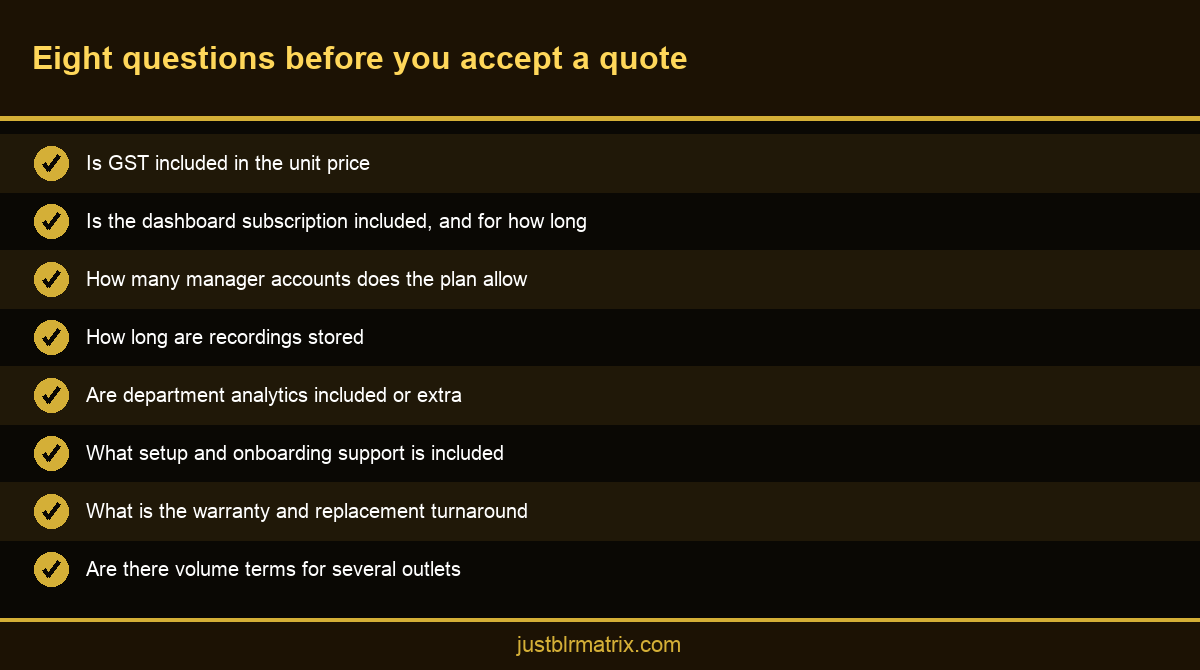
Ask four questions about any quote. Is GST included? Is the dashboard subscription included, and for how long? Is setup and staff onboarding support included? What is the warranty and replacement policy for a damaged badge? Get the answers in writing before you compare quotes.
Clarify the subscription terms in particular. Ask how many manager accounts the plan includes, how long recordings are stored, and whether analytics such as department reports carry an extra charge. These details change the real annual cost more than the unit price does.
How many badges does a venue need?
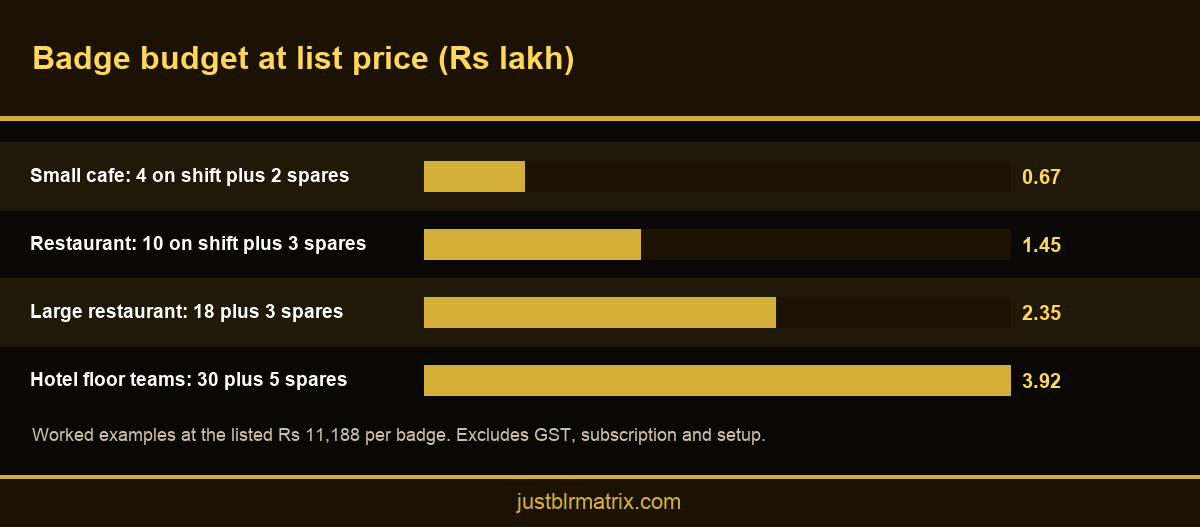
Size by the number of people on the floor at your busiest shift, not by total staff. Badges are handed over at shift change, so a team of twenty working in two shifts of ten needs roughly ten badges plus spares.
Add spares for charging and failure. Two or three spare badges per outlet keep the programme running when a badge is charging, lost or damaged. Without spares, someone works unrecorded, and gaps in the record weaken both coaching and dispute resolution.
Decide which roles wear badges. Servers, captains, cashiers, bartenders, front desk and room service staff deliver most spoken standards. Back of house teams usually do not need them, because their standards are better measured by kitchen tools than by audio.
As a worked example at the listed price: a restaurant with ten front of house staff on its busiest shift, plus three spares, needs thirteen badges, or about Rs 1.45 lakh at Rs 11,188 each before tax and subscription. A hotel covering front desk, concierge, room service and its restaurant will need more. Run the same calculation with your own rosters.
Multi outlet groups should price the full rollout but buy in phases. Pilot one outlet, prove the numbers, and then extend. Ask whether volume terms apply when several outlets are ordered together, and whether one dashboard can serve every outlet so the operations team sees a single view of compliance.
The running costs after purchase
Three running costs belong in the budget. The first is the subscription, if your plan includes one. The second is charging and handover, which needs a charging point, a storage place and a simple sign out process so each recording links to the right person.
The third, and the one most often missed, is manager time. Someone has to review the analytics, listen to flagged interactions and hold coaching conversations. The analytics reduce the load considerably, but a fixed weekly review slot of about an hour per outlet is a realistic starting point.
There is also a setup cost in time. Writing the SOPs you want to measure, briefing staff, agreeing access and retention rules, and training managers on the dashboard all happen before the first useful report. Plan a pilot month for this.
Replacement rounds out the list. Badges are worn every shift and occasionally dropped, lost or damaged. Ask about the replacement process and turnaround, and include a small annual allowance for replacement units in the budget rather than treating each one as a surprise.
Taken together, these running costs are usually smaller than the hardware in year one and larger than it in later years, because the badges are a one time purchase while time and subscription recur. A three year view gives the most honest comparison against alternatives.
Building the return case
Use a simple return on investment model built from your own numbers. Four sources of value are worth measuring, and most venues find one or two of them carry the case.
Upsell revenue is often the fastest. If servers are expected to offer specials, pairings or desserts, compare the average bill before and after the badge. Even a small rise across every table adds up quickly, especially when it is tracked through an integrated F&B command POS.
Disputes are the second. Time stamped audio lets a manager resolve guest complaints and internal disputes objectively, which saves management time and, in some cases, avoids refunds or compensation that would otherwise be paid to close the issue quickly.
Onboarding is the third. Recording based onboarding means new joiners learn from real examples of good service, which can shorten the time before they work unaided. In a sector with high staff turnover, that saving repeats every time someone new joins.
Remakes and errors are the fourth. When order repeat backs and allergy checks are verified, fewer dishes are remade and fewer complaints arise. Count remakes for a month before the pilot so you have a baseline to compare against.
Avoid building the case on cutting supervisors. The badge supports managers rather than replacing them, and a programme sold internally as a headcount cut usually meets resistance from the people it depends on.
Comparing the badge with alternatives
Buyers often compare the badge with three alternatives. The first is more supervisors. Additional floor managers cost far more each year than a set of badges and still cannot observe every interaction.
The second is mystery shopping. It measures the full guest experience, but each visit covers only a handful of interactions. The badge provides volume, while shoppers provide an outside view, and many groups use both.
The third is video. Cameras capture visual activity, and an intelligent CCTV black box suits security and presentation. Video rarely captures clear audio of a specific server's words, which is what spoken SOPs need. Audio is also lighter to store and review.
The comparison usually ends with the badge as one layer alongside video and POS data, each covering what the others cannot. Budget them together if you plan to adopt more than one, because shared access policies and dashboards reduce the total effort.
Whatever you choose, judge it on cost per measured interaction. The badge records every spoken interaction on a shift for a small daily cost per device, which is the figure to set against a supervisor's salary or a mystery shopping contract.
Conclusion
The Kavach.ai price is Rs 11,188 per badge at list, within a typical Rs 5,000 to Rs 15,000 range depending on features and plan. Budget by busiest shift headcount plus spares, include subscription, charging and manager review time, and build the return from upsell, disputes, onboarding and remakes. Start with a one month pilot so the numbers come from your own floor. Get a quote for your team size and plan.
Frequently Asked Questions
What is the Kavach.ai price in India?
Just BLR Matrix lists the badge at Rs 11,188 on its product page. The product FAQ notes a typical range of Rs 5,000 to Rs 15,000 per unit, depending on features and subscription plan, so confirm your configuration in writing.
Is there a subscription?
The product FAQ refers to subscription plans, and recordings sync to a cloud dashboard. Ask what the plan includes: manager accounts, storage duration, analytics reports and support, and how long the subscription runs before renewal pricing applies.
How many badges do I need?
Size by the number of front of house staff on your busiest shift, plus two or three spares per outlet. Badges are handed over at shift change, so total staff numbers usually overstate how many devices a venue actually needs.
What does a typical restaurant spend?
As a worked example at list price, ten front of house staff on the busiest shift plus three spares means thirteen badges, about Rs 1.45 lakh before tax and subscription. Substitute your own roster for an accurate figure.
Which staff should wear the badge?
Roles that deliver spoken standards: servers, captains, cashiers, bartenders, front desk, concierge and room service staff. Back of house teams are usually better measured with kitchen tools than with audio recording during service, so they rarely need badges.
How much manager time does it take?
Plan a fixed weekly review slot of about an hour per outlet, focused on the interactions the analytics flag. Listening at random wastes time, while a structured review keeps the workload manageable for busy floor managers.
Where does the return come from?
Usually from higher average bills when upsell scripts are delivered, faster dispute resolution, quicker onboarding of new joiners and fewer remakes from order errors. Measure each against a baseline recorded before the pilot begins, so the improvement can be shown with evidence.
Is it cheaper than hiring supervisors?
A set of badges costs far less each year than an additional floor manager, but it supports managers rather than replacing them. Someone still reviews recordings and coaches staff, so budget that time into the plan honestly.
What else should I budget for alongside it?
Many venues add video and access control later. The service automation range lists the other floor tools, and budgeting them together lets you share one access policy and one review routine across every recording system you run.
Frequently Asked Questions
What is the Kavach.ai price in India?

Is there a subscription?
How many badges do I need?
What does a typical restaurant spend?
Which staff should wear the badge?
How much manager time does it take?
Where does the return come from?
Is it cheaper than hiring supervisors?
What else should I budget for alongside it?