Commercial Roti, Naan and Pita Machines: Price and Output
 General
Search for a roti and naan machine price and you get marketplace listings, not answers. Prices span an enormous range because the phrase covers everything from a tabletop press to a full production line. This guide explains what actually drives the price, what output each machine class genuinely delivers against its advertised figure, how dough handling changes the economics, and how to build a payback case your finance team will accept rather than a number pulled from a brochure.
Key Takeaways
- Price tracks the level of automation, not the brand, so decide which steps you want automated before comparing quotes.
- Advertised output assumes ideal dough and continuous running, and real kitchens rarely see more than seventy percent of it.
- Roti, naan and pita need different machines, and a single unit covering all three is rare in kitchen technology terms.
- Payback comes from labour redeployment and consistency, not from flour savings, so model those two lines first.
What you are actually buying at each price band
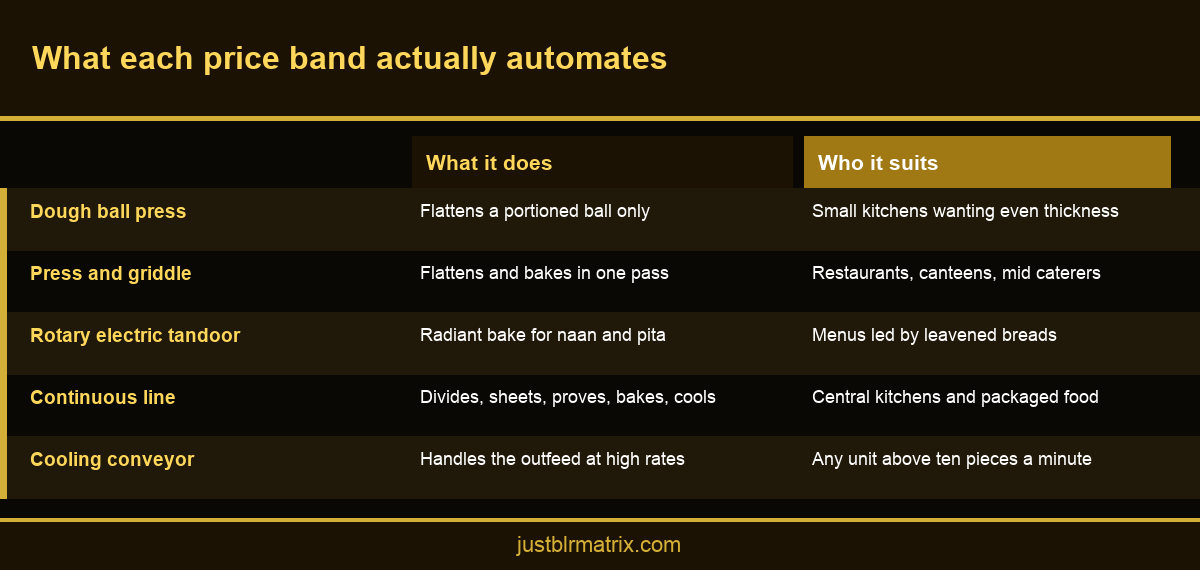
The cheapest band is a dough ball press. It flattens a portioned ball into a disc and nothing more. Somebody still portions the dough, still cooks the roti, and still stacks it. These units are genuinely inexpensive and they suit a small kitchen that wants consistent thickness without changing its staffing at all.
The middle band adds cooking. A press and griddle combination flattens and bakes in one pass, delivering a finished roti at the outfeed. This is where most Indian restaurants, canteens and mid sized caterers land, because it removes the tawa station entirely while keeping the footprint inside a normal kitchen run.
The upper band is a production line. Dough is fed from a hopper, divided, sheeted, cut, proved, baked and cooled on a continuous conveyor. These belong in central kitchens, institutional catering and packaged food production rather than in a restaurant, and the price reflects a different category of equipment entirely.
A rotary electric unit sits between the middle and upper bands and suits naan and pita particularly well. The ElectricRotoTandoor Pro electric rotary naan and pita maker handles the leavened breads that a flat griddle press struggles with, because the dough needs a hotter, more radiant heat than a contact plate provides.
Understanding these bands is what makes a price comparison meaningful. Two quotes that differ by a factor of four are almost never quoting the same category of machine, and the cheaper quote usually leaves two manual steps in place that the buyer had assumed were included in the automation.
 Comparison infographic of industrial roti making machine price bands and what each one automates
Realistic output against advertised output
Every supplier quotes rotis per hour, and every figure assumes perfect conditions. Perfect dough at the right temperature, an operator feeding continuously, no size changes, no cleaning stops and no queue at the outfeed. Real kitchens meet none of those conditions for a full hour, which is why the delivered number disappoints.
A sensible planning assumption is sixty five to seventy five percent of the advertised figure across a service period. A machine rated at nine hundred rotis an hour will comfortably deliver six hundred in practice, which is still transformative for a canteen but is not the number the business case was built on if nobody applied a discount.
Dough temperature is the single largest variable. Cold dough from the chiller resists sheeting and produces thick, uneven discs until it warms. Kitchens that keep a tempering step in the workflow hit their numbers. Kitchens that feed straight from cold storage do not, and then blame the machine for the shortfall.
Size changeover costs more time than most buyers expect. Switching between a small roti, a large tandoori roti and a naan means adjusting rollers, gap settings and often the baking time. If your menu carries three sizes, ask the supplier to demonstrate a full changeover with a stopwatch running.
Finally, count the outfeed. A machine producing ten rotis a minute needs somewhere for them to go, and a single person stacking and covering is often the real bottleneck. Institutional kitchens usually add a cooling conveyor for exactly this reason, and it should be budgeted with the machine rather than after it.
Ask the supplier to run a full hour on your own flour before you sign. A twenty minute demonstration on their dough proves nothing about the fifty first minute, which is when heat soak, dough drift and operator fatigue start showing up. Suppliers confident in their machine agree to this readily, and the ones who refuse have told you something useful.
Roti, naan and pita are three different problems
Roti is unleavened, thin and cooked fast on a hot contact surface. It suits a press and griddle design because the dough is simple and the tolerance for thickness variation is low. This is the easiest of the three breads to automate reliably, and it is where the mature machinery sits.
Naan is leavened, needs proving, and traditionally cooks against a radiant surface at high temperature. A contact griddle produces something naan shaped that is not naan. Getting a credible result needs radiant heat, which is why rotary tandoor style units exist as a separate category rather than as an accessory.
Pita needs a pocket, and the pocket forms only when the outside sets fast enough to trap steam inside. That demands a high initial deck temperature and precise dough hydration. Machines that make good pita are usually designed for pita rather than adapted, and a compromise unit will produce flat discs without pockets.
Menus that carry all three should expect two machines, not one. Operators routinely try to buy a single unit and then quietly drop naan or pita from the automated workflow because the results are unacceptable, which leaves them with a manual station they thought they had eliminated from the kitchen.
Where volumes for the second bread are modest, the sensible answer is often to automate roti fully and keep naan manual on a smaller tandoor. That decision belongs in the wider kitchen modernisation plan alongside every other station, because it changes the staffing model rather than just the equipment list.
Building a payback case that survives review
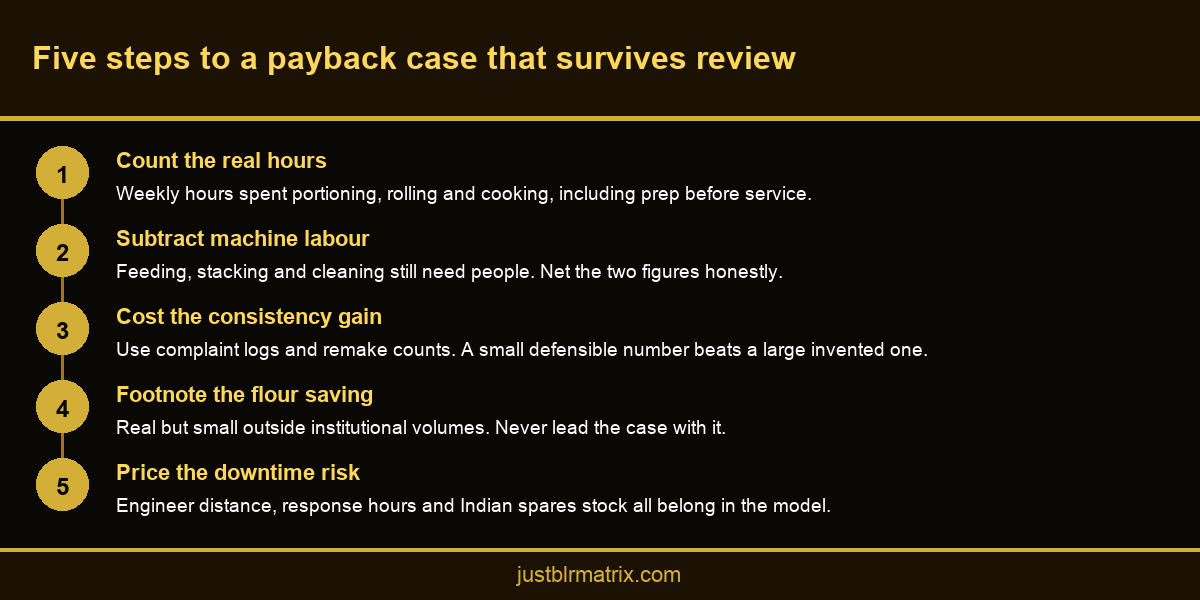
Start with labour. Count the hours currently spent portioning, rolling and cooking flatbread across a week, including the prep before service. Convert that to a fully loaded cost, then subtract the hours the machine still needs for feeding, stacking and cleaning. The difference is the recurring saving, and it is usually the largest line.
Add consistency next. Uneven rotis mean rejected plates, remakes and the occasional refunded cover. Most kitchens have never measured this, so estimate conservatively from complaint logs rather than inventing a figure. A defensible small number is far more persuasive in a finance review than an impressive unsupported one.
Flour saving is real but small, and leading with it damages your credibility. Portion control tightens a few grams per piece, which matters at institutional volumes and is negligible in a hundred cover restaurant. Include it as a footnote rather than as a headline in the business case.
Model downtime explicitly. Ask where the nearest engineer is, what the response commitment is and which spares are held in India. A flatbread machine that stops during dinner service takes a large part of the menu with it, so a lower price with a twelve day spares lead time is not the cheaper option.
Finally, sanity check the whole case against your food safety obligations. Contact surfaces, oil management and cleaning access all appear in an FSSAI inspection, and a machine that is hard to strip will cost you labour every night that no payback spreadsheet ever captured.
Present the case in ranges rather than as a single number. Give a conservative payback, a likely payback and an optimistic one, with the assumptions written next to each. Finance teams approve ranges with visible assumptions far more readily than they approve a precise figure whose derivation nobody can reconstruct six months later.
 Five step infographic showing how to build a payback case for a commercial roti making machine
Conclusion
Industrial roti making machine price in India is a meaningless figure until you fix the machine class, and the class follows from which steps you want automated. Discount advertised output by roughly thirty percent, expect two machines if your menu carries naan or pita alongside roti, and build the payback case on labour and consistency rather than flour. Get a quote and we will size the class against your daily counts.
Frequently Asked Questions
What drives the price of an industrial roti making machine?

How many rotis per hour will a machine really produce?
Can one machine make roti, naan and pita?
Why does dough temperature matter so much?
What is the payback period on a roti machine?
Do I need a cooling conveyor as well?
How long does a size changeover take?
What should I ask about service and spares?
How does a roti machine affect a food safety audit?