Commercial Sous Vide Equipment for Indian Restaurant Kitchens
 Kitchen Automation & Smart Cooking
A sous vide setup for a production kitchen is not a fine dining affectation. It is a batch cooking and consistency tool that suits Indian restaurant kitchens with unpredictable covers, long service hours and high staff turnover. Cook once, hold cold, finish to order. This guide covers the workflow, the equipment you need beyond the circulator itself, the food safety controls that make it defensible in an audit, and how to size the setup for a real kitchen.
Key Takeaways
- Sous vide is a workflow, not a machine, so budget for sealing, chilling and cold storage alongside the circulator.
- The operational win is service speed and waste reduction, because portions are cooked in advance and finished to order.
- Food safety controls must be documented, since low temperature cooking attracts more scrutiny in any food safety audit.
- Indian menus adapt well, particularly for proteins, but the finishing step is what carries the flavour profile.
What the sous vide workflow actually changes
Sous vide cooks vacuum sealed food in a precisely controlled water bath, usually at a temperature close to the target doneness. Because the water can never exceed the setpoint, the food cannot overcook. That single property is what makes the result repeatable in a way that pan or oven cooking is not.
The kitchen consequence is a change in when cooking happens. Proteins are cooked in bulk during a quiet period, chilled rapidly, and held. At service the portion is reheated and finished, which takes a fraction of the time and none of the skill that cooking from raw during a rush would demand.
That shifts the pressure off the service window entirely. A kitchen that previously needed its most experienced cook on the grill at eight in the evening can instead have that person prepping in the afternoon, with a less experienced cook finishing to a documented standard during service.
Waste falls for the same reason. Portions are cooked and sealed individually or in known quantities, so the kitchen commits only what it needs at service. Compare that against a batch of marinated protein that must be used or discarded within a day, and the difference is visible in monthly food cost.
Yield improves as well and is often the largest single saving. Cooking a protein at its target temperature rather than well above it means far less moisture is driven off, and typical weight loss falls substantially compared with high heat methods on the same cut.
The trade off is planning. Sous vide rewards kitchens that can forecast and punishes kitchens that cannot, because the lead time moves from minutes to hours. A menu built around it needs a genuine par level discipline rather than an ad hoc approach to prep.
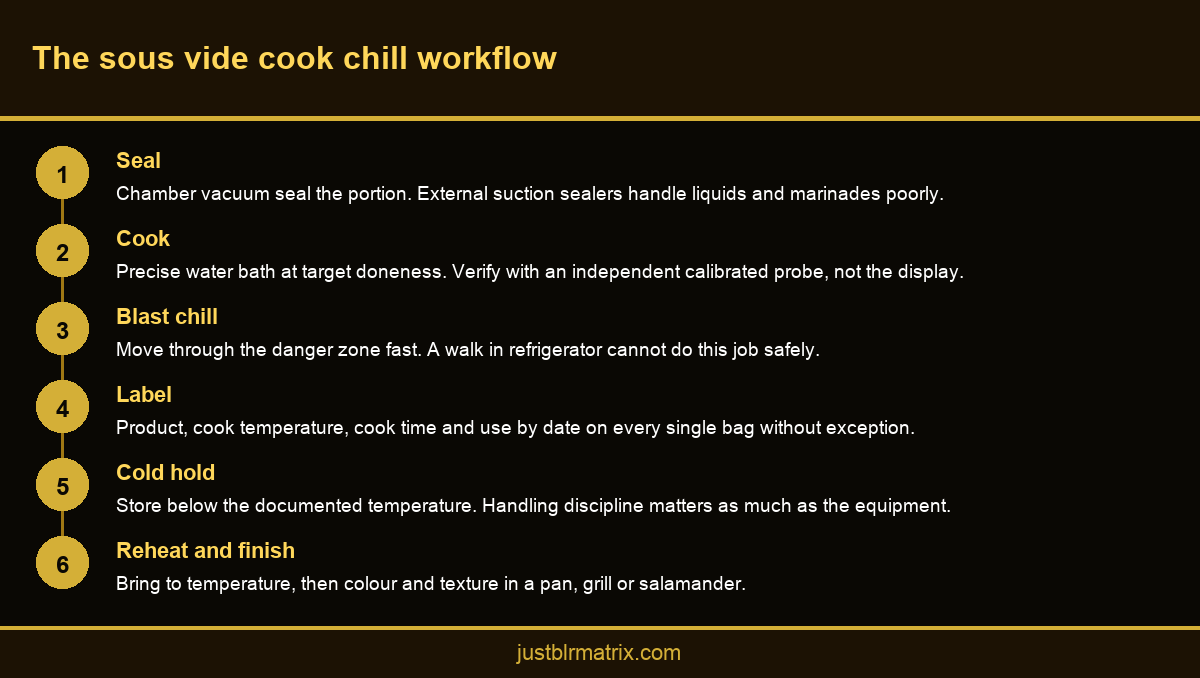 Six step infographic showing the commercial sous vide cook chill workflow from sealing to service
What you need beyond the circulator
The circulator or water bath is the cheapest part of the system and the part everyone focuses on. A commercial unit needs enough capacity and enough circulation to hold temperature evenly across a full load, which is a different specification from a domestic stick circulator dropped into a stockpot.
Vacuum sealing is essential and is where quality is often lost. A chamber sealer, rather than an external suction sealer, handles liquids and marinades properly and gives a reliable seal. Poor vacuum packing lets water in, and a flooded bag ruins both the portion and the bath.
Rapid chilling is the control that makes the whole workflow safe. Cooked food must move through the danger zone quickly, which needs a blast chiller rather than a walk in. The client's own coverage of blast chilling for restaurant kitchens explains why an ordinary refrigerator cannot do this job.
Cold storage capacity then has to grow, because you are holding cooked stock as well as raw. Kitchens adopting sous vide routinely underestimate this and end up with an overloaded chiller, which compromises temperature control across everything else stored in it.
Labelling and rotation discipline become non negotiable. Every bag needs the product, the cook date, the cook temperature and the use by date. This is not bureaucracy, it is the evidence trail that makes low temperature cooking defensible when somebody asks how you know it was safe.
Finally, the finishing equipment matters more than people expect. A sous vide portion needs colour and texture at service, which means a hot pan, a grill, a salamander or a torch. Without a strong finish the result tastes flat, and that is the commonest reason kitchens abandon the method.
Food safety and making it defensible
Low temperature cooking works on time and temperature together rather than on temperature alone. A protein held at a lower temperature for longer achieves the same reduction in pathogens as a shorter cook at a higher one. That principle is well established, but it must be documented rather than assumed.
Build the controls into a written plan aligned with HACCP principles. Identify the critical control points, which are the cook temperature and time, the chill rate, the cold hold temperature and the reheat step. Record each of them. An inspector wants to see the record, not hear the theory.
Temperature verification needs an independent probe, not just the circulator display. Circulators can drift, and a calibrated probe checked into the bath at the start of each cook is a cheap control that catches a fault before it becomes a batch of unsafe product.
Cold chain discipline after chilling is where most failures actually occur. A perfectly cooked and chilled bag left on a bench for an hour during a busy prep session undoes the entire control. Handling rules need to be trained and enforced rather than written and filed.
Shelf life should be set conservatively and written down. Many kitchens work to a shorter hold than the theoretical maximum simply because it removes argument, and published food safety guidance on cooked food storage supports a cautious approach in warm climates like ours.
Finally, train the whole section rather than one person. A workflow that only one cook understands will be operated incorrectly the first time that cook is on leave, and low temperature cooking is not a method where improvisation is acceptable.
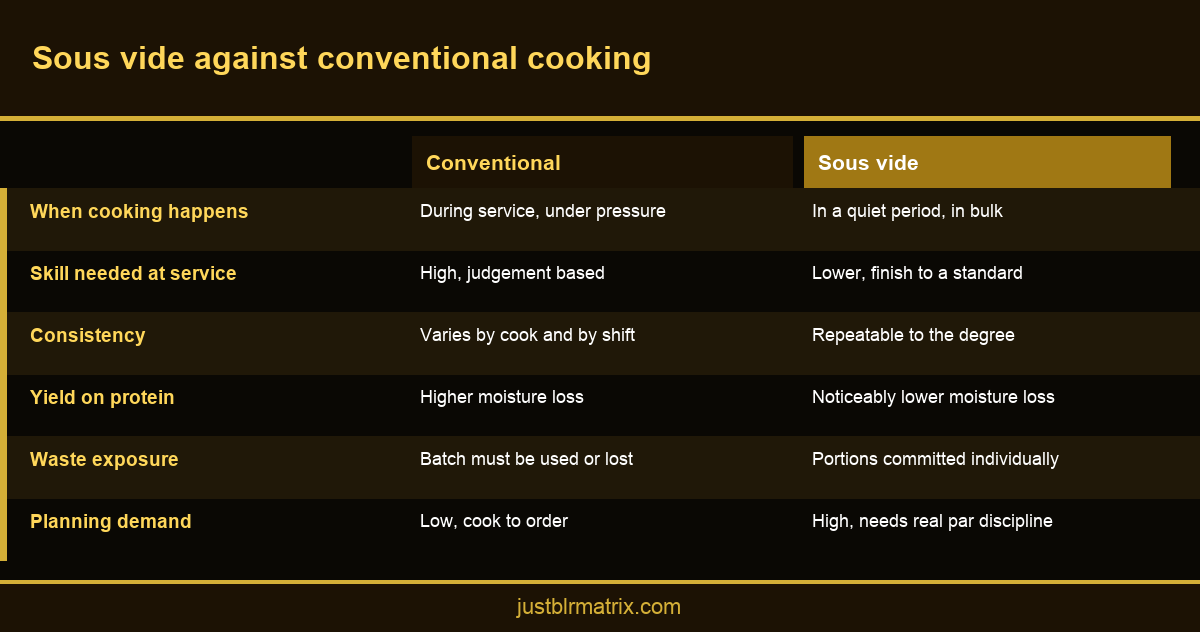 Comparison infographic of sous vide against conventional cooking in a restaurant kitchen
Sizing and adapting it to an Indian menu
Size the bath by simultaneous portions rather than by litres. Count how many portions of your highest volume sous vide item you need on hand for a busy service, then work backwards to bath volume allowing for water circulation around each bag rather than bags packed tight.
Batch scheduling matters as much as capacity. A long cook occupying the bath overnight is efficient, but it means the bath is unavailable for anything else. Kitchens running several sous vide items usually need either two baths or a disciplined rota that everyone understands.
Indian proteins adapt well. Chicken, mutton and fish all respond to controlled temperature cooking, and tougher cuts benefit most because long low temperature cooking tenderises without drying. That makes the method particularly useful where cost effective cuts are on the menu.
Spice behaves differently under vacuum and this catches people out. Aromatics intensify, chilli heat can become sharper, and some whole spices dominate. Most kitchens end up seasoning lighter in the bag and building the final flavour profile at the finishing stage instead.
Vegetarian applications are real but narrower. Root vegetables and paneer work, leafy items do not, and dals and gravies belong in a kettle rather than a bag. Being honest about that at menu development stage avoids buying capacity that never gets used.
Finally, sequence sous vide with the rest of the kitchen. It pairs naturally with bulk sauce production in a jacketed sauce kettle and with blast chilling, and treating the three as one cook chill capability produces a far better result than buying them separately over two years.
Conclusion
Commercial sous vide equipment earns its place in an Indian kitchen through consistency, yield and a calmer service, not through novelty. Budget for sealing, blast chilling and extra cold storage alongside the machine, document the time and temperature controls properly, and season lighter in the bag while building flavour at the finish. Request a demo to see the workflow sized for your menu.
Frequently Asked Questions
What is sous vide cooking in a commercial kitchen?

What equipment do I need besides the water bath?
Is sous vide safe at low temperatures?
How does it help during a busy service?
Does sous vide reduce food cost?
Do Indian spices work under vacuum?
Can vegetarian items be cooked sous vide?
What records should I keep?
How much cold storage will I need?