Commercial Onion Peeling Machines: Capacity, Price and Payback
 General
Onions are the highest volume prep item in most Indian kitchens and the least pleasant to handle. A machine that peels onions in bulk removes hours of low value labour, cuts the eye irritation that slows a prep team down, and standardises peel loss so your yield finally becomes predictable. This guide explains how these machines are priced, what the capacity ratings really mean once Indian onion sizes are accounted for, and how to build a payback case that holds up.
Key Takeaways
- Capacity ratings assume uniform medium onions, and Indian supply is rarely uniform, so discount the figure.
- Peel loss consistency is worth more than speed for a kitchen buying onions by the quintal every week.
- Peeling pairs naturally with cutting, so plan the two stations together inside your kitchen equipment layout.
- Payback comes from released prep hours plus reduced yield variance, not from the machine running faster than a person.
How commercial onion peelers work and what they cost
Most commercial peelers use abrasion, air, or a combination. An abrasive drum tumbles onions against a rough lining that strips the skin. Air peelers use compressed air after a shallow cut to blow the skin off. Combination machines cut, blow and then polish, which is what higher volume production lines generally use.
Abrasive drums are the cheapest and the most common in Indian restaurant kitchens. They are simple, tolerant of varied onion sizes, and easy to service locally. The trade off is higher peel loss, because abrasion takes some flesh along with the skin on any onion that is not perfectly firm.
Air peelers preserve more of the onion and produce a cleaner finish, but they need a compressor, which adds cost, noise and a second maintenance item. They also prefer consistent sizing, which makes them a better fit for a central kitchen with a controlled supply chain than for an outlet buying from the local mandi.
Price therefore tracks the peeling method and the batch size rather than the brand. A small abrasive batch unit sits at the bottom of the range, a larger drum in the middle, and a continuous air line at the top. Comparing quotes across methods without noticing the method is how buyers end up disappointed.
There is also a category question. Many Indian kitchens actually need a combined solution, because peeled onions still need slicing. A multi purpose vegetable, fruit and garlic peeler covers more of the prep list than a dedicated onion drum, which matters when bench space is limited and budget is single line.
Whatever the method, the machine is only one stage. Peeling feeds cutting, and the client's own vegetable cutting and peeling coverage shows how often those two stations get bought separately and then fail to line up on the bench, which wastes both the money and the floor space.
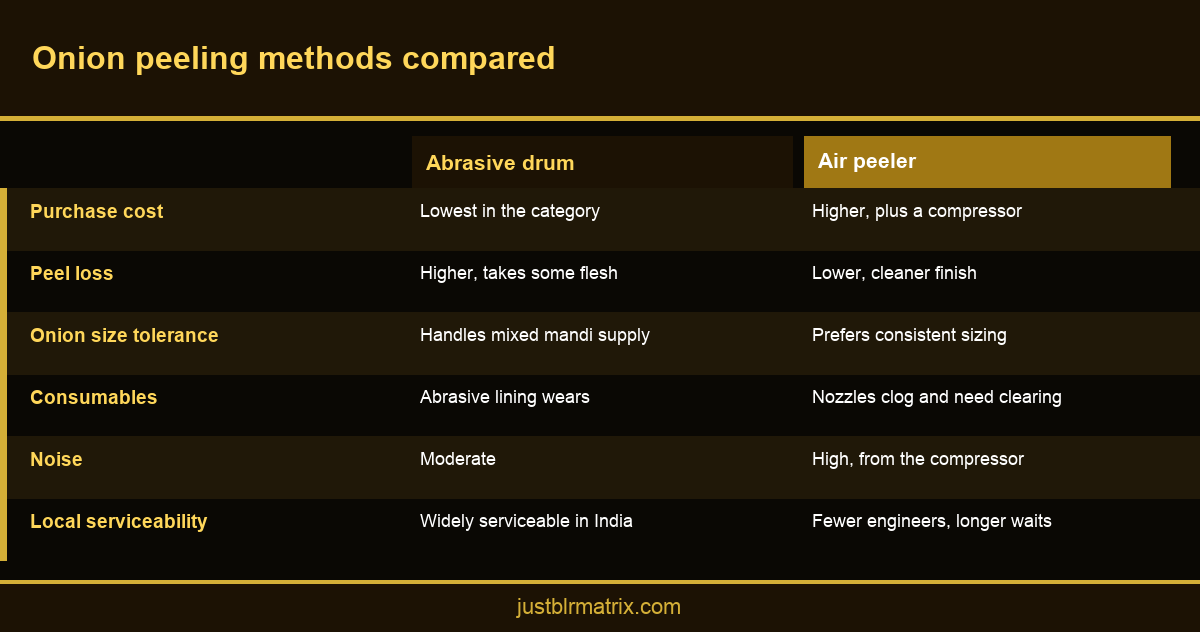 Comparison infographic of abrasive, air and combination commercial onion peeling methods
What capacity ratings mean in an Indian kitchen
Capacity is quoted in kilograms per hour and assumes uniform, firm, medium sized onions fed continuously. Indian supply is seasonal and mixed. A sack will contain small, medium and occasional very large onions, and the mix changes through the year, which means a single rated figure cannot describe your actual output.
Plan on sixty to seventy five percent of the rated figure as a working assumption. A drum rated at two hundred kilograms an hour will realistically deliver around one hundred and forty across a prep session once loading, unloading, inspection and the inevitable rework on badly peeled pieces are included in the cycle.
Rework is the line item nobody quotes. Abrasive peeling leaves residual skin at the root and neck on a proportion of every batch, and somebody has to trim those by hand. Ask the supplier what percentage typically needs touching up on Indian onions, and treat a confident zero as a warning sign rather than a selling point.
Batch machines and continuous machines behave differently under pressure. A batch drum has a fixed cycle, so output is predictable but capped. A continuous machine scales with the feed rate but needs an operator dedicated to loading. Which suits you depends on whether prep is a scheduled block or a running task.
Water use deserves attention because many peelers rinse as they work. In cities with restricted supply or expensive tankered water, a machine with a recirculating rinse and a settling tank changes the running cost materially compared with a unit that runs fresh water continuously through the whole prep session.
Finally, measure peel loss rather than accepting a claim. Weigh ten kilograms in and weigh the peeled output. The difference is your true yield, and across a kitchen buying several quintals a month, two percentage points of yield is a larger annual number than most of the labour saving being discussed.
The labour and hygiene case
Onion prep is the task that prep teams dislike most, and staff turnover in Indian kitchens is high enough that unpleasant tasks carry a real retention cost. Removing two hours of eye watering manual peeling from every morning changes the character of the prep shift in a way that a spreadsheet captures poorly but a head chef notices immediately.
The released hours are genuinely redeployable. Prep staff move to portioning, marination, mise en place and quality checks, all of which are higher value than peeling. That is the same argument that applies across automation generally, but it is unusually clean here because peeling has no craft component worth preserving.
Hygiene improves as a side effect. Fewer hands touching raw produce for fewer minutes reduces contact risk, and a machine that rinses as it peels removes soil earlier in the process. Both points are easy to demonstrate during an audit and both are the kind of control an inspector likes to see documented.
Handling also gets safer. Peeling large volumes by knife means repetitive cuts under time pressure, which is a recognised source of kitchen injuries in the guidance published for catering operations. Removing the knife from the highest volume repetitive task is a straightforward risk reduction.
Waste handling is worth designing in. Skins are bulky, wet and quick to smell in Indian heat. A machine with a dedicated waste outlet into a bin, rather than one that fills its own chamber, saves the prep team a messy job and keeps the area presentable through a long morning.
Put together, the non financial case is often what actually gets the purchase approved. Chefs argue for it on consistency and staff experience, finance approves it on released hours, and the yield improvement is the argument that convinces the owner who buys the onions.
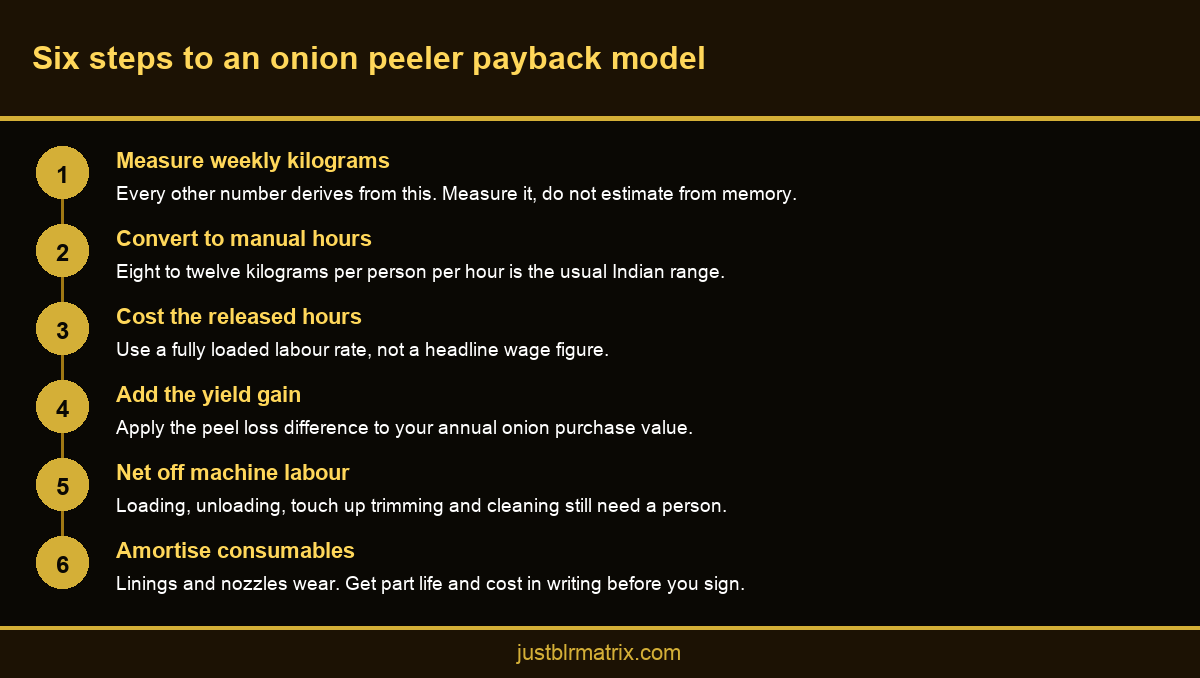 Six step infographic showing how to build a payback model for a commercial onion peeling machine
Building the payback case
Start by counting kilograms, not hours. Establish how many kilograms of onion the kitchen peels in a normal week, because every other number in the model derives from that. Most operators are surprised by the figure once they actually measure it rather than estimating from memory.
Convert kilograms to hours at your current manual rate, which is typically eight to twelve kilograms per person per hour depending on skill and onion quality. Multiply by a fully loaded labour cost. That number is the headline saving and it is usually larger than the equipment cost within the first year at volume.
Add the yield line next. If measured peel loss falls from, say, eighteen percent to fourteen, apply that difference to your annual onion purchase value. This line is often overlooked entirely and is frequently the second largest contributor to the payback calculation for a high volume kitchen.
Subtract the machine's own labour. Loading, unloading, touch up trimming and cleaning still need a person, and cleaning an abrasive drum properly takes longer than most demonstrations suggest. Netting this off honestly is what makes the case survive scrutiny rather than collapsing under the first question.
Include the consumables. Abrasive linings wear, air peeler nozzles clog, and both need periodic replacement. Ask for the expected service life and the part cost in writing, then amortise it across the payback period rather than treating the purchase as a one time cost.
Finally, decide whether the peeler should be bought alone or as part of a wider prep station upgrade. The kitchen technology guide sets out how peeling, cutting and portioning fit together, and buying the sequence once is consistently cheaper than buying it in three separate rounds.
Conclusion
A commercial onion peeling machine is one of the easiest automation cases to justify in an Indian kitchen, provided the numbers are honest. Discount the rated capacity by roughly a third, measure your own peel loss before and after, and net off the labour the machine still needs. Do that and the payback usually lands inside a year at volume. Enquire now and we will run the maths against your weekly onion purchase.
Frequently Asked Questions
How does a commercial onion peeling machine work?

What capacity should I buy?
Is an air peeler better than an abrasive drum?
How much peel loss should I expect?
Does a peeling machine also slice onions?
What maintenance does an onion peeler need?
How much water does the machine use?
Does it improve kitchen hygiene?
What is the biggest mistake buyers make?