Automatic Vegetable and Fruit Peelers for Central Kitchens
 Kitchen Automation & Smart Cooking
A central kitchen lives or dies on prep throughput, and peeling is the slowest link in that chain. An automatic vegetable and fruit peeler handles potato, carrot, garlic, ginger and soft fruit at volumes no prep team can match, and it does it with a consistent yield. This guide covers what these machines realistically deliver across different produce, how yield and throughput interact, and the checks that matter when you are buying for an Indian central kitchen.
Key Takeaways
- Central kitchens should specify by produce mix, because one machine rarely peels potato, garlic and fruit equally well.
- Yield consistency is worth more than raw speed once you are buying produce by the tonne every month.
- Peeling feeds cutting, so plan both stations together within your kitchen technology layout rather than separately.
- Water use and effluent handling are real constraints in Indian cities and belong in the specification from day one.
Why central kitchens hit the peeling wall first
A central kitchen exists to move prep out of the outlets, which concentrates the volume in one place. That concentration is the point, but it also means every prep task that scaled comfortably in a restaurant now has to scale by a factor of ten or twenty. Peeling is where that transition fails first.
The reason is that peeling does not benefit from batching in the way that cutting does. A cutter processes a large load in one pass. A knife peels one item at a time regardless of how many are waiting, so the labour requirement scales linearly with volume and quickly becomes the dominant cost on the prep floor.
Yield variance compounds it. Hand peeling removes different amounts from each item depending on who is holding the knife and how tired they are at the end of a shift. At restaurant volumes that variance is noise. At central kitchen volumes it is a purchasing line item that moves by lakhs across a year.
Hygiene risk rises too. More hands on more raw produce for more hours increases contact risk, and a central kitchen supplying multiple outlets carries the consequences of a contamination event across the whole estate rather than in one location. That asymmetry justifies controls a single restaurant might not need.
Space and staffing constraints then bite. Prep floors are sized at design stage and rarely grow, so the only way to increase throughput is to increase people per square metre, which reduces both efficiency and safety. Mechanising the slowest task is usually the only route left.
This is the same pattern the client's own vegetable cutting and peeling coverage describes at outlet level, magnified. The equipment answer is similar but the sizing, the water handling and the yield economics are entirely different at central kitchen scale.
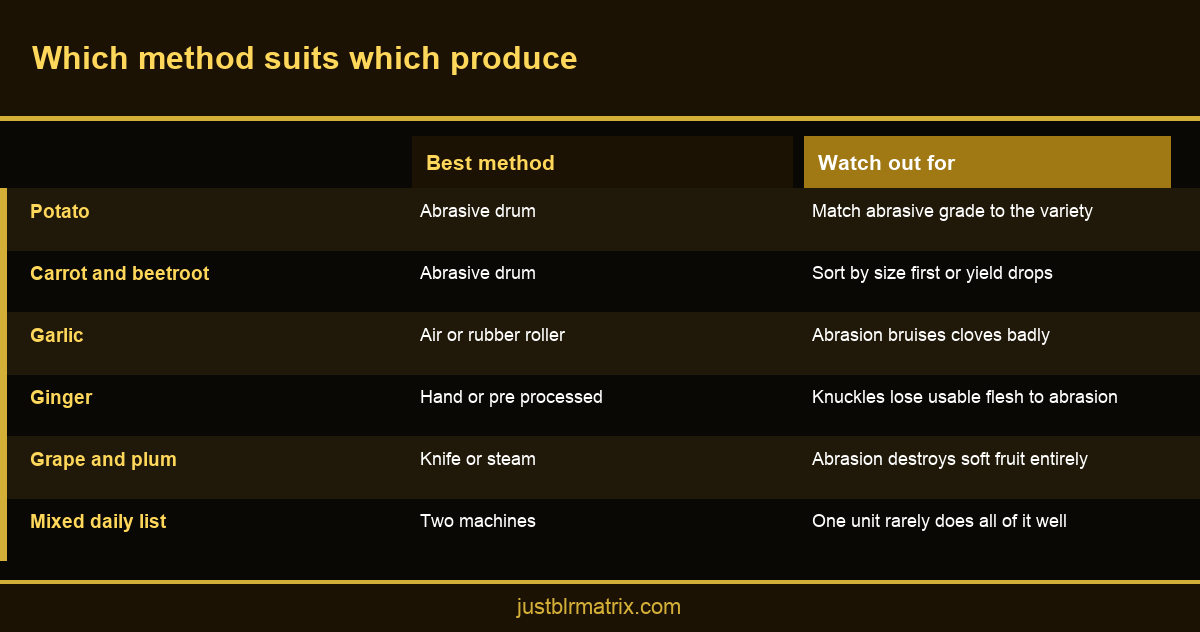 Comparison infographic of peeling methods for potato, garlic, ginger and soft fruit in a central kitchen
What peels well, and what does not
Potato is the easiest and the most common justification. An abrasive drum peeler handles potato reliably at high volume, and because potato is the highest tonnage item in most Indian central kitchens the payback arrives fastest here. Yield is predictable once the abrasive grade is matched to the variety.
Carrot, beetroot and similar firm roots behave much like potato and share the same machine. The main variable is size uniformity, because a drum tumbles mixed sizes unevenly and the small pieces over peel while the large ones under peel. Sorting before peeling improves yield noticeably at very little cost.
Garlic is a different problem entirely. Cloves are small, irregular and easily bruised, and abrasive methods damage them. Dedicated garlic peelers use air or rubber roller methods, and a machine that claims to peel both potato and garlic well should be tested on both before you believe it.
Ginger sits between the two and is genuinely difficult. The irregular shape means abrasive peeling removes a great deal of usable flesh at the knuckles. Many Indian central kitchens conclude that ginger is better handled by controlled hand peeling or by buying pre processed, and that is often the right answer.
Soft fruit needs a different technology again. Grape, plum and similar produce cannot survive abrasion, so machines designed for them use knife or steam methods. If fruit is on your list, say so at the enquiry stage rather than discovering the limitation after installation.
The practical conclusion is to specify by produce mix and to accept that a central kitchen may need two machines. A multi purpose fruit, vegetable and garlic peeler covers a wide list, but a dedicated high tonnage potato line alongside it is a common and sensible configuration.
Throughput, yield and the numbers that decide it
Throughput is quoted in kilograms per hour and, as with every prep machine, assumes ideal produce fed continuously. Plan on sixty five to eighty percent of the rated figure. Loading, unloading, inspection and touch up trimming all consume cycle time that the rating does not include.
Touch up is the line that decides real productivity. Abrasive peeling leaves residual skin in eyes and hollows, and somebody trims those by hand. Ask the supplier what percentage of output typically needs touching up on Indian produce, and treat a claim of zero as a reason to test rather than a reason to buy.
Yield is the number with the largest financial consequence. Measure it properly by weighing a known input and the peeled output, and repeat across three batches because produce varies. A two percentage point yield difference on a central kitchen's annual potato purchase is a large number.
Batch machines and continuous machines suit different operations. A batch drum has a fixed cycle and predictable output, which suits a scheduled prep block. A continuous machine scales with feed rate but needs a dedicated loader, which suits a kitchen running prep throughout the day rather than in one window.
Water consumption is a genuine constraint. Many peelers rinse continuously, and in cities where water is restricted or tankered that running cost is significant. A recirculating rinse with a settling tank changes the economics materially, and it also reduces the effluent load you have to discharge.
Effluent itself deserves planning. Peel waste is wet, heavy and quick to smell in Indian heat, and starch laden water can block drains. A machine with a proper solids separation outlet and a plan for peel disposal is far easier to live with than one that simply flushes everything into the kitchen drain.
Buying checks for an Indian central kitchen
Run a trial with your own produce, from your own supplier, in the season you buy most. Demonstration produce is always uniform and always fresh, and neither describes a mandi delivery in August. A supplier confident in the machine will agree to this without hesitation.
Ask for the abrasive grade or peeling method recommended for each item on your list, in writing. Different produce needs different aggressiveness, and a machine that can change its abrasive lining or roller set is far more useful across a varied Indian prep list than one fixed at a single grade.
Check cleaning access and how long a full strip down takes. Peel residue accumulates behind linings and in housings, and a machine that takes forty minutes to clean will be cleaned badly under production pressure. Watch the closing clean during your site visit rather than asking about it.
Confirm that all food contact surfaces and the drainage design meet the standard your FSSAI audit expects. A central kitchen carries higher scrutiny than an outlet because a single failure propagates across every location it supplies, and inspectors know that.
Establish the consumables position early. Abrasive linings, rollers and seals all wear, and the annual cost of those parts belongs in the payback model. Get part numbers, prices and lead times in writing, and confirm whether stock is held in India rather than ordered from abroad.
Finally, sequence the purchase with the rest of the prep line. Peeled produce goes straight to cutting, and a peeler that outpaces your cutting station simply relocates the bottleneck. Design the whole line once, then buy against that design.
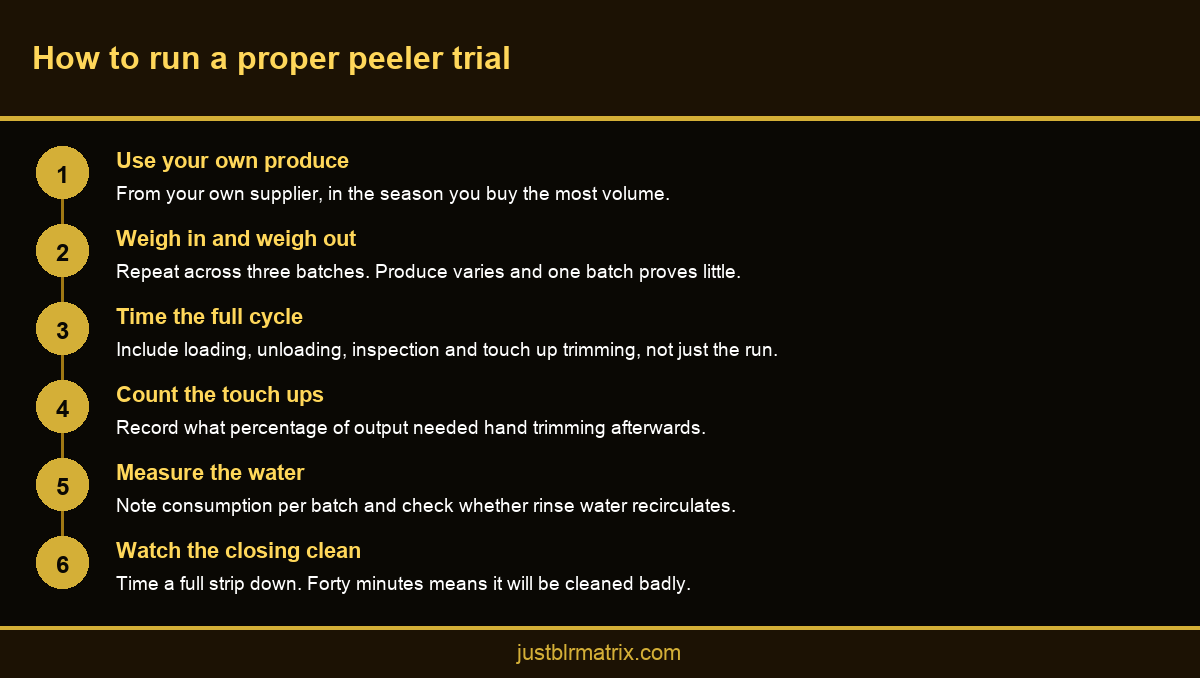 Six step infographic showing how to trial an automatic vegetable peeler for a central kitchen
Conclusion
An automatic vegetable peeler is usually the highest return prep purchase a central kitchen can make, provided it is specified against the actual produce mix rather than a generic capacity figure. Discount rated throughput by roughly a quarter, measure your own yield before and after, plan the water and effluent handling, and buy the peeler and cutter as one line. Request a demo with your own produce.
Frequently Asked Questions
What produce can an automatic vegetable peeler handle?

How much throughput will I actually get?
Why does yield matter more than speed?
Can one machine peel both potato and garlic?
How much water does a commercial peeler use?
What should I do about peel waste?
How long does cleaning take?
Should I sort produce before peeling?
What else should be bought at the same time?