Automatic and Lift Vending Machines for Hotels and Bars
 Service Automation in Restaurants
Vending in hospitality has been held back by an image problem. Most operators picture a machine that drops crisps and cans. A lift served vending unit carries the product to the collection point instead of dropping it, which means it can sell bottled cocktails, desserts, packaged meals and premium items without damage. This guide covers where these machines earn revenue in hotels and bars, how to choose the product mix, and what to check before installing one.
Key Takeaways
- Lift mechanisms remove the drop, which opens vending to fragile and premium products rather than only packaged snacks.
- The business case is the unstaffed hours, so compare against no sale at all rather than against a staffed counter.
- Placement and product mix decide utilisation far more than machine specification does in any service automation rollout.
- Cashless only is the sensible default in India, and it removes the entire cash handling burden from the project.
What lift vending changes about the category
A conventional vending machine pushes product off a coil and lets it fall into a collection tray. That works for crisps and cans and destroys almost everything else. It is the single constraint that has kept vending out of hospitality settings where the product is worth more than a hundred rupees.
A lift mechanism replaces the drop with a carrier. A platform collects the item at the shelf and lowers it gently to the collection point, so a glass bottle, a dessert in a box, a plated meal or a fragile pastry arrives intact. That mechanical change is what makes the category relevant to hotels and bars.
The commercial consequence is a higher average transaction value. A machine selling packaged snacks generates small transactions. The same footprint selling bottled cocktails, premium desserts, chilled meals and travel essentials generates transactions several times larger, against broadly similar fixed costs.
Temperature control extends it further. A refrigerated lift machine holds chilled and frozen product safely, which brings ready meals, desserts and beverages properly into range. In a hotel that is the difference between a snack machine and a genuine late night food offer.
Product presentation improves too, and in hospitality that matters. Guests can see what they are buying clearly, packaging is not battered, and the machine itself can look appropriate in a well finished lobby rather than looking like something borrowed from a railway platform.
The trade off is cost and footprint. Lift machines are more expensive and generally larger than coil machines, so the higher transaction value has to be real rather than hoped for. That makes product mix and placement the decisive planning questions rather than afterthoughts.
 Infographic showing six hospitality locations where automatic vending machines generate revenue
Where these machines actually earn money in hospitality
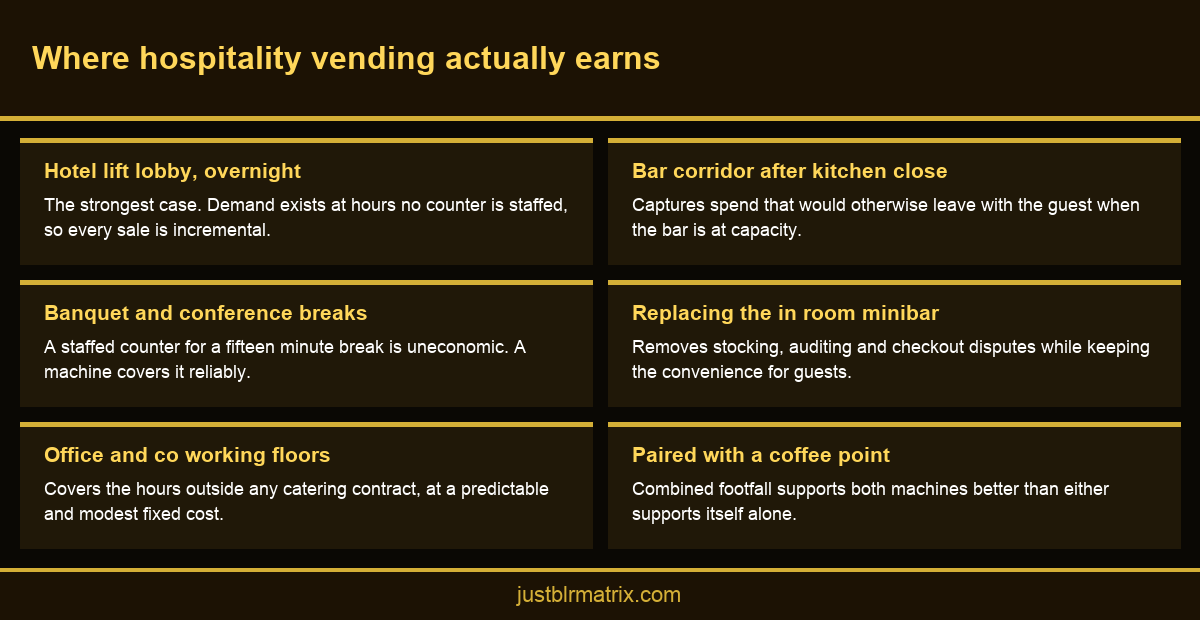
The strongest use case is the unstaffed hour. Hotel lobbies between late night and early morning, bar corridors after the kitchen closes, banquet areas between functions and office floors outside catering hours all generate demand that currently goes unmet because staffing them is not viable.
That framing matters for the business case. The comparison is not against a staffed counter that would sell more, it is against no sale at all. Any revenue in those hours is incremental against a largely fixed cost, which makes the payback arithmetic unusually forgiving.
In hotels the second use case is the in room alternative. Minibars are expensive to stock, expensive to audit and a persistent source of billing disputes. A well placed lobby or lift lobby machine gives guests the same convenience without the stocking, the shrinkage or the argument at checkout.
In bars the use case is the extension of trade. A machine offering bottled cocktails, mixers and snacks in a corridor or a smoking area captures spend that would otherwise leave with the guest, particularly at the point in the evening when the bar itself is at capacity.
Banquet and conference spaces are the underused case. Delegates want water, snacks and coffee between sessions, and a staffed counter for a fifteen minute break is uneconomic. A machine covers it and removes a recurring operational headache from the events team.
Across all of these the machine works best as part of an unattended service point rather than alone. Pairing it with a coffee bot creates a small self service hub, and the combined footfall usually supports both better than either supports itself.
Placement, product mix and utilisation
Placement decides everything. High traffic, well lit, visible from a natural path, and near where people already pause. Lift lobbies, corridors between function rooms, the route from reception to the lifts and the area near a late night entrance all perform well.
Machines placed for installation convenience underperform badly. A power point in a service corridor is easy to connect and invisible to guests, and the machine will sell a fraction of what the same unit sells in a lobby while carrying identical fixed costs every single month.
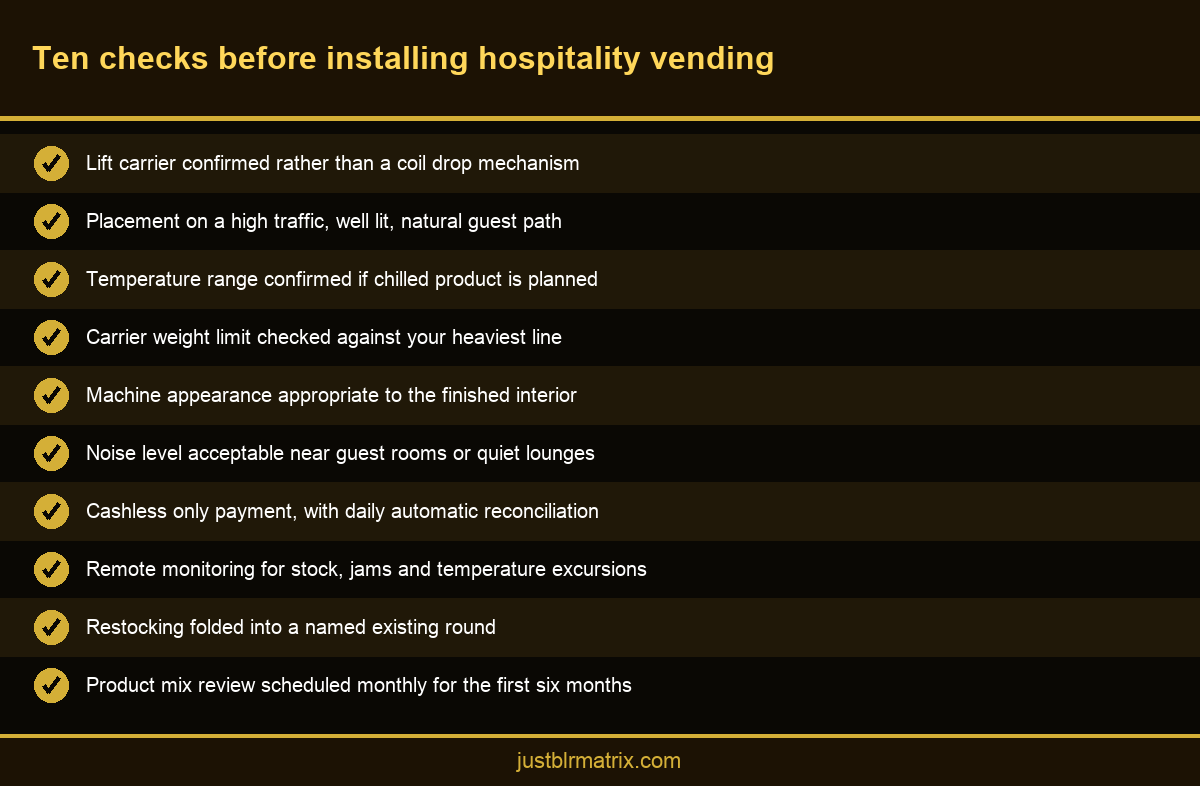
Product mix should be built from data rather than assumption. Start with a broad selection, then use the sales reporting that every modern machine provides to cut what does not sell and expand what does. Reviewing monthly for the first six months is what separates a good performer from a mediocre one.
Price it as convenience, not as a discount channel. Guests buying at one in the morning are buying availability, and pricing at or slightly above outlet level is accepted. Pricing below outlet level cannibalises your own bar without adding volume.
Stock the things people actually want at those hours. Water, soft drinks, chocolate and crisps are the base, but the items that lift the average transaction are the ones the machine could not previously carry, which means desserts, bottled drinks, chilled meals and travel essentials.
Watch expiry management closely on chilled and fresh lines. A machine holding perishable product needs a rotation discipline, and building it into the restocking round from day one prevents the slow accumulation of out of date stock that quietly kills the offer.
 Checklist infographic of ten checks before installing an automatic vending machine in a hotel or bar
Payment, restocking and buying checks
Cashless only is the right default in India, where UPI has normalised paying by code. Card and code based payment cover almost every guest, and removing cash removes the float, the collection round, the reconciliation and the theft risk in one decision. The small number of cash preferring guests is not worth the operational burden.
Reconciliation should be automatic. Machine sales must reconcile against settlement reports daily without anyone opening a spreadsheet, and any discrepancy should raise an exception. Ask how the reporting works and whether it feeds into your existing financial reporting or sits in a separate portal.
Restocking needs a named route and a named person. Building it into an existing housekeeping or facilities round is the usual answer, and it works far better than creating a new task that competes with everything else on a busy morning.
Remote monitoring turns restocking from a schedule into a response. A machine that reports low stock, a jammed carrier or a temperature excursion means somebody attends when needed rather than on a fixed round, and an empty machine is fixed before a guest finds it.
For buying checks, confirm the temperature range if you intend to carry chilled product, the carrier weight limit for heavier items, the machine's appearance against your interiors, and the noise level if it stands near guest rooms or a quiet lounge area.
Finally, decide the ownership model. Buying, leasing and revenue share with an operator are all available, and the right answer depends on whether you want the margin or the simplicity. Weigh it as you would any self service settlement decision, on total cost rather than capital outlay alone.
Conclusion
An automatic vending machine earns its place in hospitality when it is a lift machine, sited on a busy path and stocked from real data. The business case rests on the hours nobody is staffed, so measure it against no sale rather than against a counter. Go cashless, build restocking into an existing round, and review the product mix monthly. Request a demo of lift vending for your property.
Frequently Asked Questions
What is a lift vending machine?

Where should a vending machine be placed in a hotel?
Can vending replace an in room minibar?
Should the machine accept cash?
How should I choose the product mix?
How should vending be priced?
Who restocks the machine?
Can it hold chilled or frozen products?
What ownership models are available?