Auto Lifting Commercial Fryers: Consistency and Oil Life
 Kitchen Automation & Smart Cooking
Frying is the station where quality and cost drift fastest. A fryer with auto lifting baskets takes the timing decision away from a busy cook, and good oil management takes the cost decision away from guesswork. Together they hold product quality steady and extend oil life substantially. This guide covers how auto lifting works, why oil life is the real economic argument, and what to check before you buy for an Indian kitchen.
Key Takeaways
- Auto lifting removes the human timer, which is the single largest cause of inconsistent fried product.
- Oil is the dominant running cost at this station, and filtration extends its life far more than temperature alone.
- Recovery time between loads decides real throughput, not the tank size printed in the kitchen equipment brochure.
- Fryer siting, extraction and fire safety belong in the specification, not in a conversation after installation.
What auto lifting actually fixes
In a manual deep fryer, the basket comes out when the cook remembers. On a quiet shift that works well. During a rush, with three baskets down, a wok going and tickets stacking, the cook estimates. Product then comes out undercooked or over browned, and neither result is visible until the guest complains.
Auto lifting removes that decision. The basket lowers, a programmed timer runs, and the basket rises automatically at the end of the cycle. Every batch of fries is in the oil for the same number of seconds, which makes the output identical regardless of who is on the station or how busy the pass has become.
The consistency benefit compounds across a chain. A programmed time per product is transferable between outlets, so a recipe card becomes a machine setting rather than an instruction somebody may or may not follow. That is what makes fried product taste the same in Whitefield and in Koramangala.
It also protects the oil. Product left too long carries more colour, sheds more particulate and darkens the oil faster. Overcooking is therefore not just a quality problem, it is an oil cost problem, and the two are usually measured separately when they should be measured together.
Safety improves as a side effect. Reaching over hot oil to lift a heavy basket during a rush is a common cause of burns in commercial kitchens, and a lift mechanism removes that reach entirely. Insurers and auditors both treat this favourably where it is documented.
None of this is exotic technology. Auto lifting has been standard in international quick service for years and is only now becoming common in Indian independent kitchens, which is precisely why it still represents a real operational advantage for operators who adopt it early.
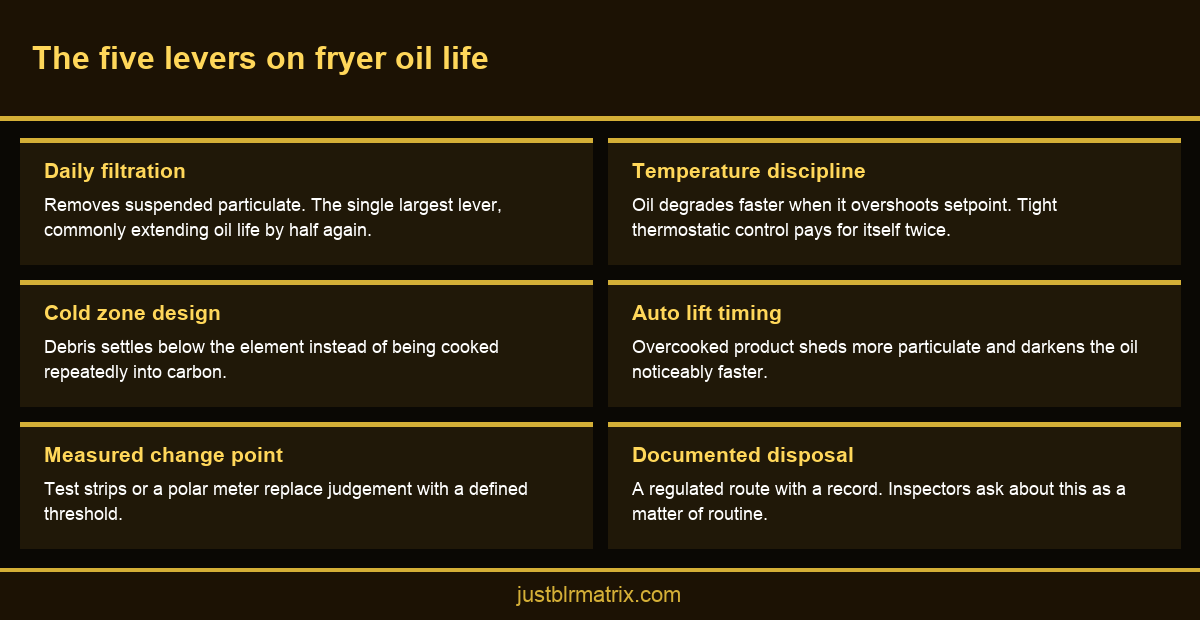 Infographic showing five factors that determine commercial fryer oil life
Oil life is the real economic argument
Oil is the largest recurring cost at a fry station and the one most operators manage by feel. Oil is changed when it looks dark or smells wrong, which means some kitchens change too early and waste money while others change too late and serve poor product. Neither is a controlled process.
Filtration is the single biggest lever. Removing suspended particulate daily, rather than weekly, slows the breakdown that darkens oil and transfers off flavours. Kitchens that filter properly commonly extend usable oil life by half again, which on a high volume fryer is a substantial annual figure.
Temperature discipline is the second lever. Oil degrades faster the hotter it runs, so a fryer that overshoots its setpoint between loads is quietly shortening its own oil life. Accurate thermostatic control and a tight recovery curve therefore pay for themselves twice, in product quality and in oil.
Cold zone design is the third. A fryer with a proper cold zone below the element collects crumb and debris where it is not being repeatedly cooked, which slows carbonisation. Tanks without an effective cold zone burn their own sediment continuously and darken far faster as a result.
Measuring rather than guessing is what makes the whole thing manageable. Simple oil quality test strips or a polar compound meter give you a number, and a number lets you set a change threshold rather than relying on somebody's judgement at the end of a long shift.
Disposal is the final piece and increasingly a compliance matter. Used cooking oil has a regulated disposal route in India, and kitchens are expected to document where it went. Building that record into the oil change routine costs nothing and answers a question inspectors now ask routinely.
Recovery time, throughput and honest sizing
Recovery time is how quickly the oil returns to setpoint after a cold load drops in. It is the specification that determines real throughput, and it is rarely quoted prominently because it is less flattering than tank capacity or connected load.
A fryer with slow recovery cooks the second batch in cooler oil, which means longer cooking, more oil absorbed into the product and a greasier result. In practice this shows up as the third and fourth batches of a rush being visibly worse than the first, which cooks usually attribute to the product rather than the fryer.
Size by batch weight and cycle, not by litres. Establish the weight of your largest single load, the target cook time, and how many loads you need consecutively at peak. Those three numbers point to a tank size and a recovery specification far more reliably than a capacity figure alone.
Multiple smaller tanks usually outperform one large tank for a varied menu. Separate tanks prevent flavour transfer between products, allow different temperatures, and let you continue serving while one tank is being filtered or changed. That flexibility is worth more than raw volume in most Indian menus.
Electric and gas both work, and the choice follows the wider kitchen decision rather than the fryer decision. Kitchens moving toward gas free operation gain a cooler working environment and lower extraction load, while gas remains cheaper per unit of energy where a supply is already installed.
Finally, plan the loading and unloading path. A fryer that requires the cook to turn and walk with a hot basket is a hazard and a delay. Landing space directly beside the tank, at the same height, is a small design decision that improves both safety and speed every single service.
Buying checks, extraction and fire safety
Ask for the recovery time from a full cold load, measured and in writing. Ask for the thermostatic accuracy and the overshoot on the setpoint. Ask how the cold zone is configured. These three answers describe how the fryer will behave in your kitchen far better than the headline specification does.
Check the filtration arrangement carefully. Built in filtration that can run between services is used. External filtration that requires draining into a trolley is used far less often, because it is unpleasant and takes time. The one that gets used daily is the one that saves you money.
Confirm the drain and disposal route. A fryer drain that discharges cleanly into a portable container, at a sensible height and without splashing, is a small feature that makes a large difference to how willingly the team performs the oil change on schedule rather than deferring it.
Extraction is a specification, not an afterthought. Frying produces grease laden vapour that must be captured, and a kitchen hood sized for the fryer's output protects the whole kitchen environment. Undersized extraction is a recurring cause of grease accumulation and fire risk.
Fire suppression belongs in the same conversation. A fryer is the highest fire risk appliance in most kitchens, and suppression over the fry station is expected by insurers in commercial premises. Confirm what the supplier provides and what your fit out contractor must add.
Finally, look at the fry station within the whole line. It interacts with prep, holding and service, and the kitchen technology guide sets out how those stations sequence so that adding fryer capacity does not simply create a queue at the pass instead.
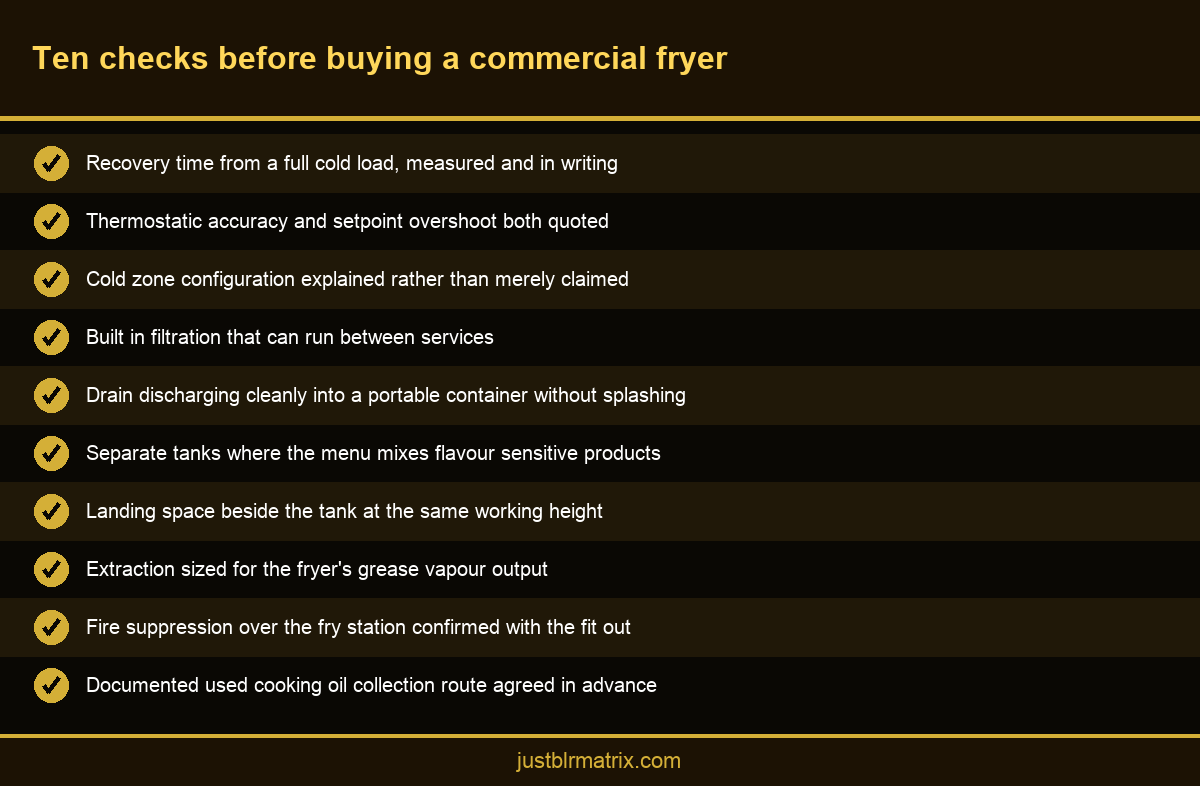 Checklist infographic of ten buying checks for an automatic deep fryer machine
Conclusion
An automatic deep fryer machine with auto lifting baskets fixes the timing problem that causes inconsistent fried product, and disciplined oil management fixes the cost problem that sits underneath it. Size by batch weight and recovery time rather than by litres, insist on filtration that will actually be used daily, and treat extraction and suppression as part of the purchase. Get a quote for your fry station.
Frequently Asked Questions
What does an auto lifting fryer actually do?

How much can filtration extend oil life?
Why is recovery time more important than tank size?
Should I choose one large tank or several smaller ones?
How do I know when to change the oil?
What is a cold zone and why does it matter?
Is an electric fryer better than gas?
What extraction does a commercial fryer need?
How should used cooking oil be disposed of?