2027 Restaurant Tech: Why AI POS Systems Are Becoming the Default, Not the Upgrade
 General
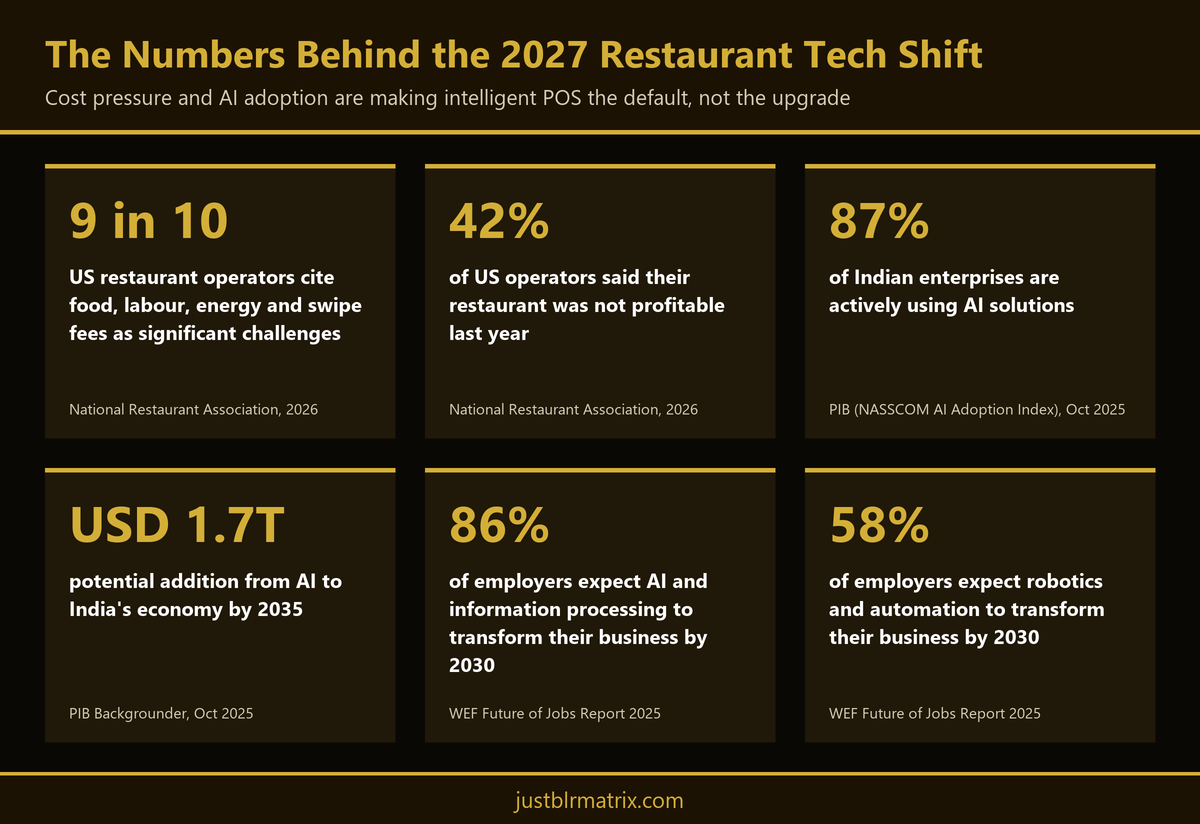
Restaurant margins are under real pressure, and the National Restaurant Association's 2026 State of the Restaurant Industry findings show more than 9 in 10 operators naming food, labour, energy and swipe fees as significant challenges. That squeeze is changing how owners think about the billing counter. An AI POS system for restaurants is no longer a shiny add on for flagship outlets. To see how that looks on a working floor, book a walkthrough with the Just BLR Matrix team in Bengaluru. This guide explains why the shift is happening, what an intelligent POS should actually do, and how to plan your move before 2027 arrives.
Key Takeaways
- Cost pressure, hiring gaps and fast AI adoption are turning the AI POS system for restaurants from an optional upgrade into the default starting point for 2027.
- The real value comes from linking billing, inventory, staff and kitchen data, including the kitchen automation machinery for restaurants India operators are planning for 2027.
- Owners searching for a smart POS billing system for cafes near me should judge vendors on integration, local demos and support, not just on how the billing screen looks.
Why Cost Pressure Is Rewriting the Restaurant Tech Stack
Restaurants are not buying technology for novelty anymore. They are buying it to protect thin margins. When food, labour and energy costs all rise together, owners need a system that shows exactly where money leaks out of every shift. That is the job a modern AI POS system for restaurants now takes on.
The same National Restaurant Association report found that 42 percent of operators said their restaurant was not profitable last year. Nearly three quarters plan to hire, yet they expect difficulty finding experienced managers and chefs. Operators say they will invest in digital ordering and payments, loyalty programs and automation to remove friction and control costs. Those figures come from the US market, but the pattern will feel familiar to Indian owners. Rents climb, skilled staff move on, and a busy weekend can hide a loss until the month closes. A traditional billing machine records the sale and stops there. An AI POS system for restaurants reads the same sale as data, linking it to stock, staff and wastage, so problems show up in hours instead of weeks.
That difference is why the conversation has moved. A few years ago, owners asked whether they could afford intelligent billing. Heading into 2027, more of them ask whether they can afford to run without it. When every rupee of margin counts, an AI POS system for restaurants pays its way by spotting overstaffed shifts, slow moving dishes and stock that disappears without a matching sale.
India's AI Momentum Makes Intelligent Billing the Baseline
India is adopting AI faster than most owners realise. Government data shows enterprises, startups and retail businesses moving quickly, and global employers expect AI to reshape their operations by 2030. For restaurants, that momentum means intelligent billing will soon be the expected standard rather than a premium choice.
According to the Government of India's backgrounder on how AI is transforming the country, 87 percent of Indian enterprises are actively using AI solutions on the NASSCOM AI Adoption Index. Nearly 89 percent of new startups launched last year used AI in their products or services, and consumer goods and retail rank among the leading adoption sectors. The same release notes AI could add USD 1.7 trillion to India's economy by 2035. Globally, the World Economic Forum's Future of Jobs Report 2025 finds 86 percent of employers expect AI and information processing to transform their business by 2030, while 58 percent say the same of robotics and automation. The outlook for 2027 is clear. Suppliers, payment partners and guests will increasingly assume your outlet runs on connected, intelligent systems. Restaurants that still rely on standalone billing will find it harder to plug into that wider ecosystem, while those running an AI POS system for restaurants will already have the data foundation in place.
What an AI POS System for Restaurants Should Do in 2027
Calling a billing screen "AI powered" does not make it intelligent. An AI POS system for restaurants worth buying in 2027 should connect front of house and back of house in one view. It should answer plain questions, flag problems on its own, and give owners of multiple outlets the same visibility everywhere.
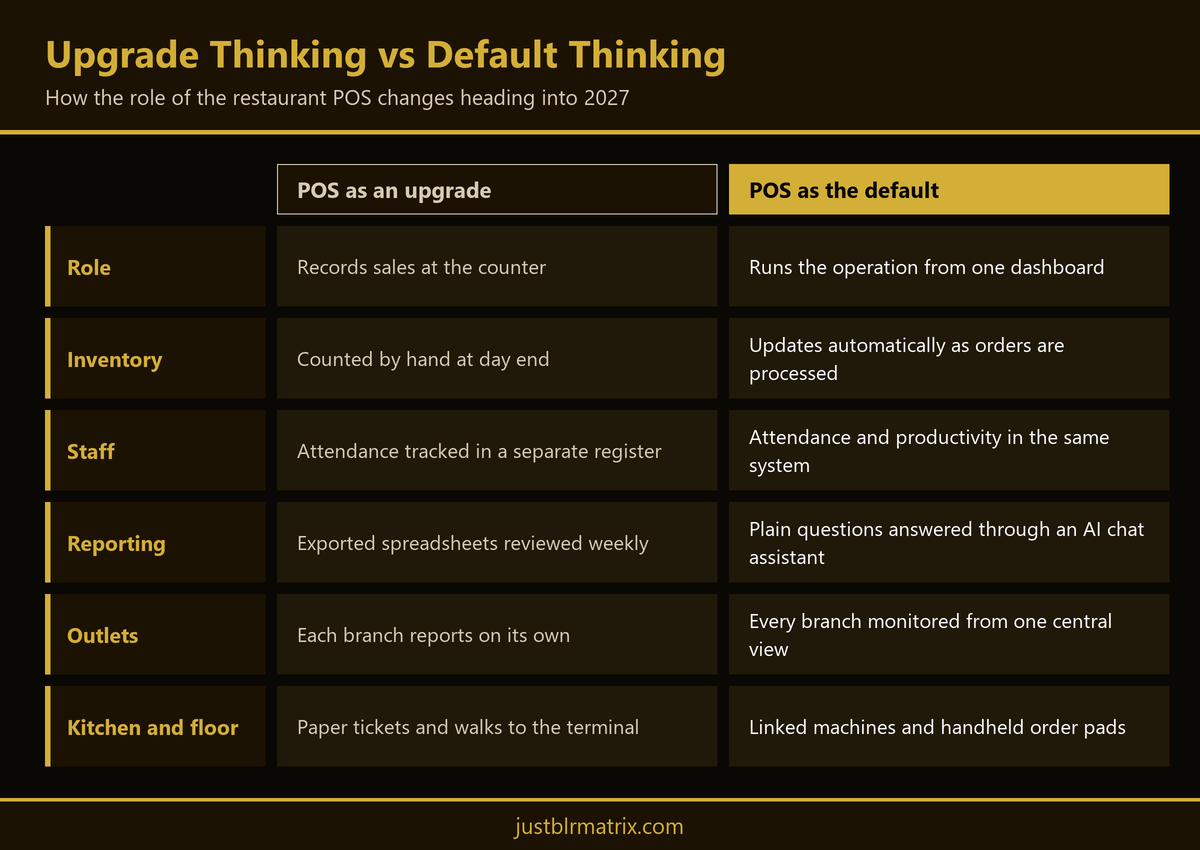
Start with integration. The Just BLR Matrix AI Command POS brings reservations, table allocation, staff attendance, CCTV variance monitoring, inventory tracking, machine reporting and customer history into a single dashboard. Owners query it through a simple chat interface with the JB AI Bot, so asking about peak hours or stock levels feels like sending a message. Inventory updates automatically as orders are processed, and guest history supports personalised service and targeted offers. For multi outlet groups, every branch can be monitored from one central dashboard. If you want the full feature walkthrough, read our deep dive into how the Command POS works. The key test is simple. Does the system reduce manual reporting and help you decide faster? If not, it is still an upgrade, not a default.
Connecting the POS to the Kitchen and the Floor
A POS that only sees the billing counter misses most of the story. The biggest gains appear when sales data reaches the kitchen line and the service floor. Linked machines and handheld devices turn every order into a coordinated workflow rather than a chain of handoffs.
On the line, owners are pairing their AI POS system for restaurants with kitchen automation machinery for restaurants India operators can deploy today. A robotic cooking system such as the Cooking Bot MAX uses preset recipes with precise temperature and ingredient control, which keeps taste consistent across shifts. When orders flow straight from billing to the kitchen, prep teams see demand in real time and waste less. On the floor, smart waiter manager pads let servers punch orders at the table instead of walking to a terminal. The workforce angle matters too. The World Economic Forum says workers can expect 39 percent of their existing skill sets to be transformed or become outdated between 2025 and 2030. Connected tools shorten training because the system guides staff through each step, which helps when experienced hires are hard to find.
How Cafes and New Outlets Should Choose Their System
Smaller cafes and new outlets face the same decision with tighter budgets. The right choice is rarely the cheapest billing app. It is the system that can grow with the business, connect to future machines and come with real local support when something breaks on a busy evening.
If you are a cafe owner comparing options for a smart POS billing system for cafes near me, use a short checklist. First, confirm the system links billing with inventory and staff data, not just receipts. Second, ask whether it can connect to the kitchen automation machinery for restaurants India operators are adding for 2027, plus any bar machines you may buy later. Third, check multi outlet support, even if you run one site today. Fourth, insist on a live demo with your own menu. Just BLR Matrix runs demos in Bengaluru every week, so you can test the workflow before committing. Finally, browse the full catalogue of service, kitchen and bar machines to plan which automation you may add in stages. Buying the POS first and machines later works well when the POS was built to connect from day one.
New outlets have one extra advantage. They can design workflows around the system from the start instead of retrofitting habits later. Choosing an AI POS system for restaurants before the fit out is finished means table layouts, kitchen tickets and staff roles can all follow the same data flow from opening night.
Conclusion
The shift is already under way. Cost pressure, staffing gaps and rapid AI adoption are pushing restaurants toward connected systems that see the whole operation. In 2027, an AI POS system for restaurants will be the foundation that billing, inventory, staff and kitchen machines plug into, rather than an extra bought after everything else. Owners who plan now can phase in automation without disrupting service. Ready to see it working on a real floor? Schedule a demo with Just BLR Matrix in Bengaluru and map the first steps for your outlet.
Frequently Asked Questions
What is an AI POS system for restaurants?

Why are AI POS systems becoming the default for restaurants in 2027?
How is an AI POS different from a traditional billing machine?
Can an AI POS connect with kitchen automation machinery?
What should cafes look for in a smart POS billing system?
Does an AI POS help restaurants with multiple outlets?
How does AI help with restaurant staffing challenges?
Is AI POS technology only suitable for large restaurant chains?
Where can I see an AI POS demo in Bengaluru?