Agni.ai Price: Robotic Kitchen Feeder Cost and Payback
 Kitchen Automation & Smart Cooking
The Agni.ai price on the Just BLR Matrix website is Rs 4,75,522, but that figure alone will not tell you what the feeder costs your kitchen. The feeder works only with a Cooking Bot, it needs setup time, and its return depends on your menu and volume. This guide breaks the Agni.ai price into the parts that matter: the module, the robot it pairs with, the costs after delivery, and a simple payback model. If you are new to the module, start with the product page and its channel layout.
Key Takeaways
- The listed Agni.ai price is Rs 4,75,522 for the feeder module, before the Cooking Bot it needs.
- Total line cost runs from roughly Rs 10.6 lakh with a Mini to about Rs 22.1 lakh with a Super Max, at list prices.
- Compare the robotic kitchen feeder price against labour, waste and lost repeat orders, not against labour alone.
What the listed Agni.ai price includes
The Agni.ai price covers the feeding module. Just BLR Matrix lists 8 automated liquid channels, 2 thick liquid channels for pastes and gravies, 4 fresh ingredient channels, and dedicated oil and water channels. That is the hardware that stores ingredients and releases them into the pan on a programmed schedule.
It does not include the cooking robot. The feeder is designed for the Cooking Bot range, so the first budgeting decision is which robot you need. The compact Mini model is listed at Rs 5,87,409, the MAX at Rs 12,86,707 and the Super Max at Rs 17,34,257.
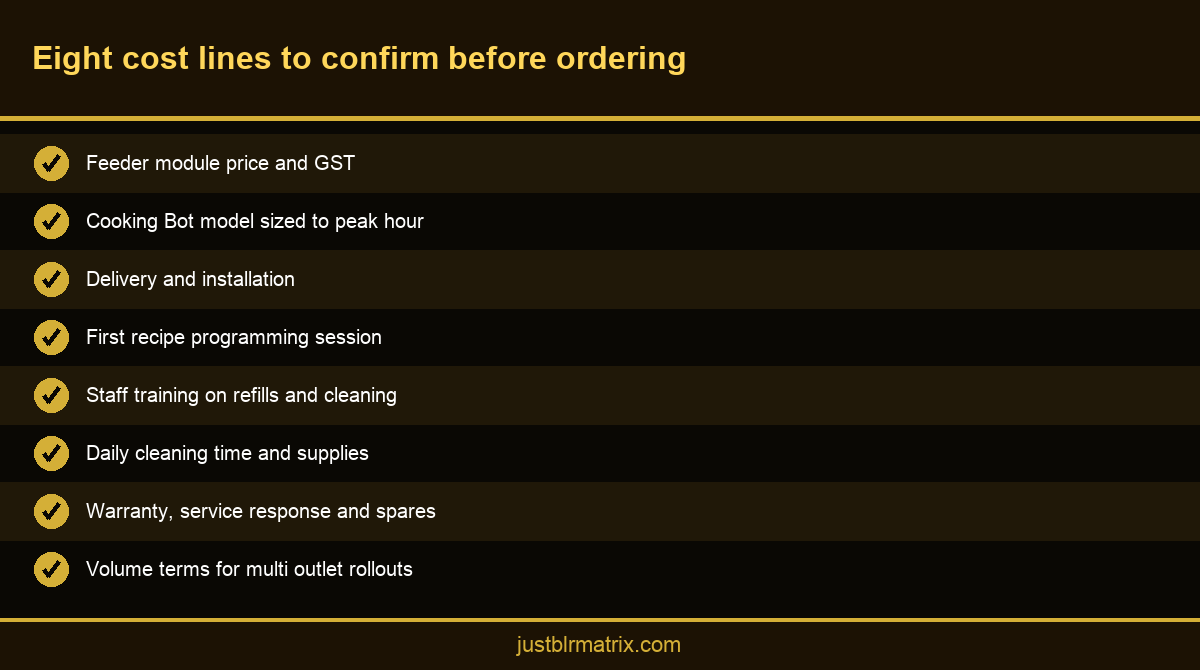
Ask three questions about any quote. Does the figure include GST? Does it include delivery and installation? Does it include the first recipe programming session? Answers vary by order and location, so get them in writing. A clear quote prevents the most common budget surprise, which is finding that commissioning was priced separately.
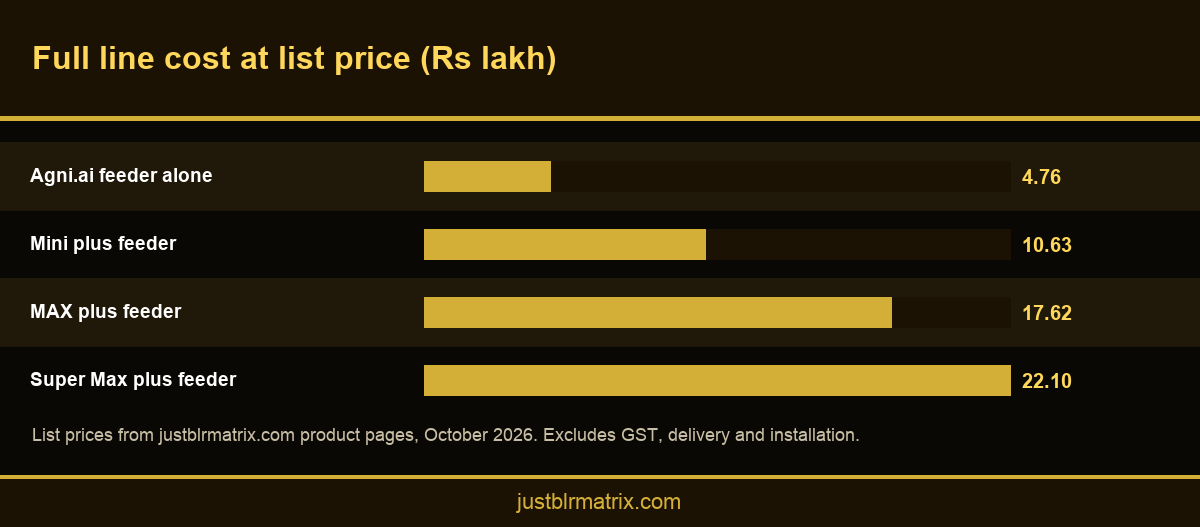
Feeder plus Cooking Bot: the full line cost
Because the feeder and the robot are bought together, the useful number is the combined line cost. At list prices, a Mini with the feeder comes to about Rs 10.6 lakh. A MAX with the feeder is about Rs 17.6 lakh. A Super Max with the feeder is about Rs 22.1 lakh. These are arithmetic on published prices, before tax and before any negotiated terms.
Choose the robot by peak hour demand, not by budget alone. The MAX handles 4 to 7 kg batches, which suits most chain outlets, canteens and food courts. Buying a Mini to save money and then running it flat out at lunch is a false economy, because queues cost more than the price difference.
Multi outlet groups should price the full rollout, not one site. A chain planning five kitchens needs five lines, a programming plan that serves all five, and a spares arrangement. Ask whether volume terms apply when several lines are ordered together. Whether you buy one line or five, size every outlet the same way.
It also helps to separate capital cost from cost per portion. Divide the line cost by the portions you expect it to cook over three years. A busy MAX line spreads its price across a very large number of plates, which is why the same equipment looks expensive in a quiet kitchen and inexpensive in a busy one.
The costs that arrive after delivery
A true cost picture uses the idea of total cost of ownership: everything you spend across the life of the equipment, not just the invoice. For the feeder, five items belong in that picture.
Recipe programming is the first. Your head chef will spend days building and testing programmes. That time has a cost even when it is not billed. Training is the second. Staff need to learn refills, clean downs and basic fault handling.
Cleaning is the third. Channels need a daily clean down, which takes staff time and cleaning supplies. Power is the fourth, though the feeder is a small draw beside the robot it serves. Service and spares are the fifth. Pumps and valves wear, so ask what is covered, for how long, and how quickly a technician reaches your city.
None of these is large on its own. Together they can add a meaningful share to year one costs, so include them before you compare the line against your current kitchen. Our ten ways automation cuts kitchen costs sets out where the savings usually come from.
Budgeting by kitchen type
The same Agni.ai price produces very different returns depending on where the line is installed. It helps to budget against the kitchen you actually run rather than an average. Start by writing down three numbers for your site: portions cooked on the dishes you plan to automate each day, cooks assigned to those pans per shift, and the number of outlets that cook the same recipes. Those three figures decide most of the outcome.
A cloud kitchen running several delivery brands from one site usually sees the fastest return. Menus are fixed, volumes are concentrated into lunch and dinner peaks, and ratings depend on consistency. One trained operator can supervise more than one line, which spreads labour savings further.
A QSR chain outlet sits close behind. The menu is narrow and repeated hundreds of times a day. The bigger gain for a chain is that the recipe is programmed once and pushed to every outlet, so a new site opens with the same taste as the flagship rather than after months of training.
A central kitchen or institutional caterer usually pairs the feeder with the Super Max. Capital cost is higher, but batch sizes are large and the work is repetitive, so the cost per portion falls quickly once the line is running every day.
A lounge, bar kitchen or kiosk often pairs the feeder with the Mini. The case here rests less on headcount and more on running a short food menu without hiring a dedicated cook for every shift. Late night service, when cooks are hardest to roster, is where this setup tends to justify itself.
A fine dining or frequently changing menu is the weakest fit. The programming effort repeats with every menu change and the volume per dish is low. These kitchens should treat the feeder as a later step, once a stable core menu exists.
A simple payback model for your kitchen
Payback is the number of months it takes for savings to repay the investment. It is a simpler cousin of return on investment, and it is the figure most owners use to decide. Build it from your own numbers using three inputs.
First, labour. Just BLR Matrix states that the system reduces labour dependency by 60 to 80 percent. Treat that as the manufacturer's figure. Count the cooks who currently stand at the pans you plan to automate, and estimate how many you would redeploy or not replace.
Second, waste. Precise dispensing reduces over seasoning, remakes and spoiled batches. Take your current monthly food cost on the automated dishes and apply a conservative reduction you can defend.
Third, consistency. This is the hardest to measure and often the largest. Track repeat order rates and complaint counts before and after. Even a small lift in repeat orders on a delivery brand compounds quickly.
As an illustration only: if a MAX line with the feeder costs about Rs 17.6 lakh and saves Rs 1.5 lakh a month in labour and waste combined, payback is roughly twelve months. Replace both numbers with your own. A kitchen that cannot show a credible monthly saving should wait until volume grows.
Conclusion
The Agni.ai price of Rs 4,75,522 is only the starting point. Add the Cooking Bot that suits your peak hour, budget for programming, training, cleaning and service, and then test payback against your own labour, waste and repeat order numbers. Kitchens with a fixed menu at volume usually see the strongest case. Get a quote that sets out the module, the robot and commissioning as separate lines.
Frequently Asked Questions
What is the Agni.ai price in India?
Just BLR Matrix lists the Agni.ai feeder at Rs 4,75,522 on its product page. That covers the feeding module only. The Cooking Bot it works with is priced separately, so confirm GST, delivery and installation in any written quote.
Do I need to buy a Cooking Bot as well?
Yes. The feeder is designed specifically for the Cooking Bot range and does not cook on its own. The feeder dispenses ingredients while the robot heats, stirs and fries, so the two are budgeted and commissioned together as one line.
What does a complete line cost?
At list prices, a Mini with the feeder is about Rs 10.6 lakh, a MAX with the feeder about Rs 17.6 lakh and a Super Max with the feeder about Rs 22.1 lakh, before tax and any negotiated terms for multi line orders.
How do I compare the robotic kitchen feeder price with labour?
Count the cooks at the pans you plan to automate, apply a defensible reduction, then add waste savings and the value of fewer complaints. Compare the monthly total against the line cost to estimate payback in months for your kitchen.
What costs come after delivery?
Recipe programming time, staff training, daily channel cleaning, power and ongoing service and spares. None is large alone, but together they add a meaningful share to year one costs and belong in any honest comparison.
How long does payback usually take?
It depends entirely on your volume and labour costs. A kitchen with a fixed menu at high volume recovers the investment far faster than a low volume site. Build the model from your own numbers rather than relying on a headline figure.
Is there a discount for several lines?
Ask the team directly. Groups ordering lines for several outlets should request pricing for the full rollout, including programming support and spares, because buying site by site often costs more and complicates the service arrangement later.
Can I finance the purchase?
Many operators finance commercial kitchen equipment through bank loans or equipment leasing. Discuss options with your lender and ask the team about payment terms, and see the full range of kitchen machines if you are budgeting for several machines.
Which kitchens get the best return?
Cloud kitchens, QSR chains and central kitchens running a fixed menu at volume. The programming effort is the same for any dish, so the return grows with how often each programmed dish is cooked across shifts and outlets every day.
Frequently Asked Questions
What is the Agni.ai price in India?

Do I need to buy a Cooking Bot as well?
What does a complete line cost?
How do I compare the robotic kitchen feeder price with labour?
What costs come after delivery?
How long does payback usually take?
Is there a discount for several lines?
Can I finance the purchase?
Which kitchens get the best return?